Octa Aspects and Planetary Rulers: Is There a Link?
I spend an unhealthy amount of time placing different symbolic systems next to each other and asking why they seem to keep describing suspiciously similar things.
Sometimes the answer is obvious. Humans have been wrestling with the same problems for thousands of years, so naturally our myths, religions, psychological models and astrological systems keep circling identity, love, responsibility, power, meaning and everything hiding underneath the floorboards of consciousness.
Other times the similarities become specific enough that I stop and stare at them for a while.
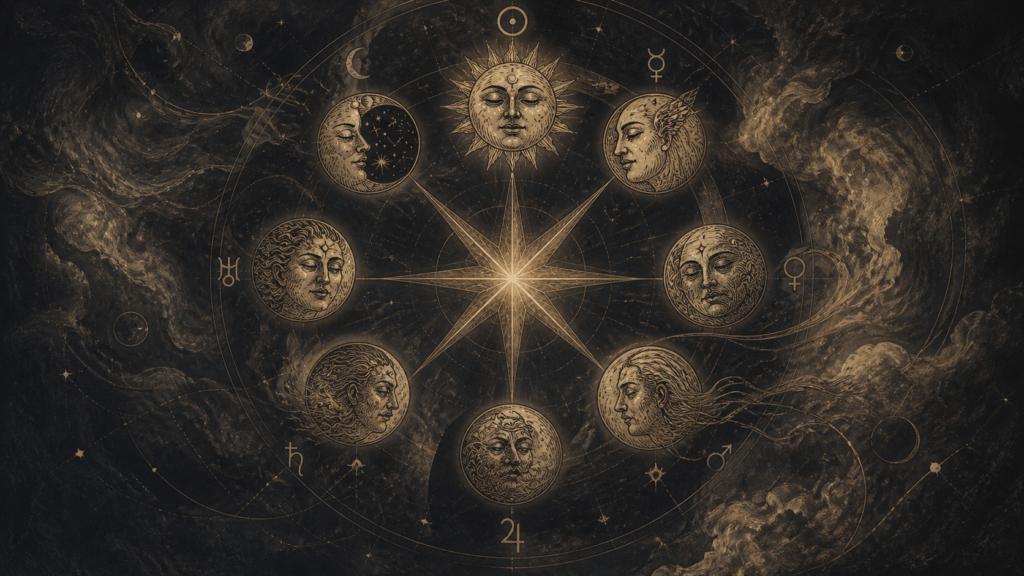
That happened when I placed the eight Octa Aspects next to the eight planetary rulers.
Some connections immediately looked almost too convenient. Venus beside the Heart? Fine. Mars beside the Blade? Nobody is exactly falling off their chair. Jupiter beside the Compass also feels fairly natural once you stop reducing Jupiter to luck and remember its older associations with wisdom, belief, religion, law and expansion.
Then the stranger correspondences started appearing.
Mercury began looking suspiciously comfortable beside the Mask. Saturn belonged beside the Hammer far more naturally than I expected. The Moon started making sense as the Crown once I remembered that my Crown has almost nothing to do with sitting on a golden chair telling peasants what to do. And Uranus, strangely enough, began resembling the Shadow.
That last one made me uncomfortable enough to investigate the entire thing more seriously.
Not because I believed I had discovered some hidden ancient doctrine that astrologers had somehow misplaced for two thousand years. I am suspicious whenever somebody discovers an ancient secret that conveniently happens to look exactly like the system they invented last Tuesday.
The question was much simpler.
Are Octa Aspects and planetary rulers describing similar psychological functions from two completely different layers?
The more important part turned out to be understanding what those layers actually are.
Sun and Spark: The Centre of the Self
This distinction was missing from my first interpretation.
Octa Element Aspects describe a current elemental configuration. They are dynamic. The Spark, Mask, Heart, Hammer, Blade, Crown, Compass and Shadow describe which elemental forces are presently operating most strongly through different psychological territories: identity, adaptation, bonding, stability, movement, responsibility, meaning and rejected material. They are not meant to become another personality prison where somebody takes one quiz at twenty-seven and spends the rest of their life defending the result like a medieval family crest.
The configuration can change.
Not every Tuesday because somebody annoyed you in traffic, obviously. But sustained life changes can reorganize people. Trauma changes how we operate. Healing changes us. Parenthood changes us. Responsibility changes us. Grief, love, prolonged stress, isolation, success, failure and years of consciously developing qualities we once avoided can gradually change which forces we rely upon and how those forces behave.
That is already built into the Octa Aspect model. It describes how the elemental system is arranged now, not some eternally frozen identity.
The planetary layer is different.
A natal chart is inherited at birth. Whether someone interprets astrology literally, symbolically or somewhere in the strange swamp between those positions, the original planetary arrangement does not rewrite itself because you survived a terrible relationship or finally learned how to establish a boundary.
The chart remains the chart.
The person living through it changes.
That gives me a much cleaner distinction than calling one system “personality” and the other “astrology.”
Planetary functions describe inherited archetypal architecture. Octa Element Aspects describe current elemental configuration.
One is fixed in origin.
The other is responsive through development.
And no, by “fixed” I do not mean that astrology sentences you to behave exactly one way forever. That would be a remarkably depressing worldview and also make personal development rather pointless. I mean that the natal architecture itself remains fixed while our relationship with that architecture can mature, distort, compensate, integrate and evolve.
Once I separated those layers, the correspondences started making much more sense.

Sun and Spark: The Centre of the Self
The Sun beside the Spark is probably the least controversial connection in the entire model.
The Spark asks one simple question: Who am I when all the adaptive noise falls away?
It represents instinctive identity, authenticity and the mode of being that feels closest to the psychological centre. It is not necessarily the person you perform socially or the person you believe you should become. It is the force that tends to feel most naturally you.
The Sun has occupied similar symbolic territory for a very long time.
Traditional astrology connected the Sun with vitality, prominence, authority and visibility. Modern psychological astrology expanded that language toward conscious identity, selfhood and the organizing centre of the personality. Those are not exactly identical ideas, but they live comfortably inside the same house.
What interests me is that Sun and Spark may describe the same territory while answering different questions about it.
The Sun belongs to inherited architecture. It describes a stable solar principle inside the natal structure.
Spark asks which element currently dominates the centre of lived identity.
That means I do not believe your Sun sign automatically tells me your Spark. If that were true, there would barely be any reason for Spark to exist as a separate concept.
Instead I see Sun and Spark almost like two different maps laid over the same region.
The Sun says: Here is the archetypal territory of selfhood.
The Spark asks: Which elemental force is currently occupying that territory most strongly?
That distinction is much more interesting than forcing them to become identical.

Mercury and Mask: The Translator
Mercury beside the Mask originally looked less obvious because the word mask carries too much theatrical baggage.
People hear Mask and imagine deception. False personality. Somebody smiling politely while mentally planning your disappearance into a lake.
That is not what the Octa Mask means.
The Mask represents adaptive expression: the way we learn to interface with other people, environments and expectations. It is how we negotiate social pressure, translate ourselves into different contexts and develop behaviours that help us function. It can absolutely become deceptive when distorted, but adaptation itself is not deception.
You probably speak differently to your partner than you speak to a client. You explain something differently to a five-year-old than to a university lecturer. You may become more diplomatic around one person and more direct around another because successful communication requires some awareness of what the receiving mind can actually process.
That is where Mercury enters.
Traditional Mercury governs communication, language, exchange, trade, interpretation and mediation. Mythologically Mercury is the messenger, the mover between worlds, the one carrying meaning across boundaries.
That is extremely close to the functional territory of the Mask.
Mercury translates information.
Mask translates the self.
Both become distorted when translation stops serving truth and begins serving manipulation. Intelligence can become camouflage. Adaptability can become shapelessness. Communication can become performance so refined that even the person performing it eventually forgets what they originally meant.
I therefore see Mercury as the inherited interpretive function, while Mask describes the current elemental strategy through which adaptation happens.
Mercury does not determine the Mask.
It describes the kind of psychological job the Mask is performing.

Venus and Heart: What Becomes Valuable Enough to Let Close
Venus and Heart barely require persuasion.
Traditional Venus governs attraction, affection, pleasure, relationship, beauty, harmony and value. The Heart governs love, bonding, vulnerability, intimacy and the way we open ourselves to connection.
Pretty suspicious resemblance.
The deeper connection appears when Venus stops being reduced to romance and pretty things.
Venus is fundamentally connected with valuation. What do I desire? What do I appreciate? What feels worth protecting, maintaining or drawing closer? What receives my affection and investment?
The Heart asks a very similar question from inside relationship.
What becomes valuable enough that I lower the wall?
That does not mean Heart is simply another word for Venus. The distinction between static and dynamic matters here perhaps more than anywhere else.
Your natal Venus does not change every time your relationship history changes.
Your way of loving absolutely can.
Someone may spend part of their life loving through Fire: passionately, dramatically, intensely and directly. After years of betrayal or responsibility, they may begin loving through something much more guarded, practical or protective. The underlying Venus architecture remains. The elemental Heart configuration may evolve.
That gives both systems room to say something useful instead of forcing one to replace the other.
Venus describes the inherited relational function.
Heart describes how elemental energy currently occupies that territory.

Saturn and Hammer: Reality Eventually Sends the Invoice
Saturn and Hammer are another pairing that becomes obvious once the metaphor is understood correctly.
The Hammer asks: How do I create stability?
It represents discipline, structure, resilience, consistency and the capacity to maintain something after inspiration has packed its bags and gone somewhere more interesting.
Saturn has been associated with limitation, time, endurance, hardship, responsibility and consequence for centuries. The language changes between traditions, but Saturn repeatedly returns to one unpleasant lesson humans spend enormous amounts of energy trying to avoid:
Reality has requirements.
You can believe in something passionately and still fail because you never built a structure capable of carrying it. You can have talent and no discipline. Vision and no patience. Ambition and no consistency. Everybody loves potential until potential has to wake up early and repeat the same boring process for three years.
That is where Saturn becomes the Hammer.
Not because ancient astrologers were sitting around saying Saturn literally represents hammers. The symbol is mine.
The function is much older.
A hammer transforms repeated impact into structure. Used properly, it builds something capable of surviving pressure. Used badly, it simply destroys whatever happens to be underneath it.
Saturn behaves similarly in symbolic terms. Discipline can mature into mastery or harden into rigidity. Responsibility can become competence or turn into oppressive control. Boundaries can preserve something valuable or slowly become prison walls.
So Saturn represents the inherited relationship with limitation and structure.
Hammer describes which elemental force currently handles the work of making things endure.
And as somebody who has repeatedly tried replacing consistency with sudden bursts of obsessive productivity, I unfortunately find this pairing personally offensive in its accuracy.

Mars and Blade: Force Needs Direction
Mars beside Blade is probably the most visually obvious pairing after Venus and Heart.
Traditional Mars governs conflict, heat, aggression, competition, courage and forceful action. Blade governs motivation, ambition, assertion, confrontation, power and the ability to move through resistance.
The important part here is not violence.
Violence is simply one crude expression of force.
Sometimes Martial action means fighting. Sometimes it means finally telling somebody no after ten years of allowing them to walk through every boundary you were too scared to defend. Sometimes it means leaving. Sometimes it means staying and fighting for something difficult. Sometimes it means making a decision and accepting that every real choice destroys alternative futures.
A blade separates.
That is psychologically important.
Every boundary is a cut between what enters and what does not.
Every decision cuts away possibilities.
Every commitment eliminates other paths.
Every act of self-definition eventually requires saying: this belongs here, and that does not.
Mars supplies the force required to make that separation real.
The Blade therefore represents the current elemental expression of movement and confrontation, while Mars represents the inherited archetypal principle of mobilized force.
A healthy Blade cuts deliberately.
A distorted Blade swings simply because something resisted it.
Most of us have experienced both versions.

Moon and Crown: Responsibility Is Not the Same as Authority
Moon and Crown looked wrong to me until I remembered what my own Crown actually means.
If Crown meant status, monarchy, fame or sovereign authority, giving it to the Moon would make very little sense. The Sun would probably have the strongest claim, with Saturn and Jupiter lurking nearby filing paperwork for the position.
But Octa Crown is not about wearing something shiny on your head while everybody else bows.
The Crown represents responsibility beyond the self.
It governs protection, family, leadership, duty, stewardship and what we choose to carry because something outside our own immediate needs has become important enough to influence our decisions.
That changes everything.
Traditional Lunar symbolism is deeply connected with home, family, nurture, care, emotional security, belonging and motherhood. The Moon preserves continuity. It remembers. It attaches. It protects what has entered its emotional world.
That is extremely close to the Crown once the symbol stops being confused with kingship.
Parenthood may be the clearest example.
Before another life becomes your responsibility, you can structure many choices primarily around yourself. Then somebody enters your world whose wellbeing matters enough that freedom changes shape. You still possess freedom, but every choice now carries consequences beyond your own comfort.
That is Crown.
The Moon does not fit because it rules.
It fits because it carries.
The distortion also maps cleanly. Protection can become smothering. Care becomes control. Responsibility becomes martyrdom. Family becomes ownership. Somebody begins by trying to keep loved ones safe and eventually cannot tolerate them becoming independent because independence feels suspiciously similar to abandonment.
A mature Crown protects life without trying to imprison it.
That feels profoundly Lunar to me, although I would never pretend traditional astrologers called the Moon “the Crown.” This is an Octa interpretation built on very old Lunar territory.
Jupiter and Compass: Humans Need Direction Before They Have Certainty
Jupiter and Compass almost feel designed for each other.
Traditional Jupiter is connected with growth, philosophy, religion, law, wisdom, generosity and expansion. The Compass governs meaning, understanding, perspective, spirituality and whatever helps us orient ourselves when certainty disappears.
And certainty disappears a lot.
There is no mathematical proof telling you which person you should spend your life with. There is no perfect experiment revealing which sacrifice will eventually feel meaningful. Nobody hands you a spreadsheet at eighteen showing which decision will make seventy-year-old you grateful.
Eventually human beings have to move without knowing the entire road.
That requires worldview.
Values.
Belief.
Interpretation.
Some internal orientation strong enough to help us choose before the consequences become visible.
That is Compass.
Jupiter expands the conceptual map through experience, philosophy and possibility. Compass tells us how we navigate the expanded territory.
The interesting difference again appears through time.
Natal Jupiter remains part of the inherited architecture. But what guides us can change radically.
At twenty, someone may orient around independence.
At thirty-five, family.
After grief, perhaps spirituality.
After losing faith, perhaps reason.
After burnout, maybe simplicity.
The planet remains fixed.
The Compass evolves with the life being lived.
That is exactly the kind of distinction that makes me think these systems may complement each other without needing to become the same system.

Uranus and Shadow: The One I Would Never Call Traditional
Then we arrive at Uranus.
This is where I need to put the brakes on before somebody accuses me of smuggling eighteenth-century astronomical discoveries into Babylonian astrology.
Uranus is not a traditional planet.
Ancient, Hellenistic, medieval and Renaissance astrologers did not use Uranus because they could not exactly interpret a planet they had not discovered yet. Aquarius traditionally belonged to Saturn. Any Uranian rulership belongs to modern astrology.
So if somebody asks whether Uranus → Shadow is supported by traditional astrology, my answer is simple:
No.
And I do not need it to be.
The correspondence becomes interesting through modern Uranian symbolism.
Uranus is associated with disruption, liberation, rebellion, unconventionality, sudden change and breaking structures that have become too restrictive.
The Octa Shadow represents something different but strangely compatible: the element we currently trust least, access least comfortably or repeatedly exclude from our conscious self-image. It may surface through projection, overcompensation, disproportionate reactions and recurring friction until something previously rejected becomes impossible to ignore.
Shadow therefore does not simply mean trauma, evil, buried sexuality or whatever dramatic definition happens to look good beside a black moon graphic.
It means rejected possibility.
A gentle person might Shadow aggression.
A powerful person may Shadow vulnerability.
A chaotic person could Shadow discipline.
Somebody raised to remain invisible may Shadow ambition.
A painfully responsible person may Shadow playfulness.
The common thread is exclusion.
The conscious personality says: That is not me.
Then life repeatedly drags that quality back into the room wearing different costumes until eventually you notice the pattern.
This is where Uranus begins making sense.
Uranus disrupts established structures.
Shadow disrupts the established structure of self-perception.
The old identity says: I know who I am.
The excluded material replies: Apparently not entirely.
That does not make Uranus the traditional ruler of the unconscious. I would never write that because it simply is not true.
The connection is narrower.
Both Uranian symbolism and the Octa Shadow describe situations where something excluded from the current structure begins exerting enough pressure that the structure itself has to change.
That is not ancient doctrine.
It is an Octa interpretation.
And I actually trust an idea more when it admits where tradition ends instead of desperately dressing everything in ancient robes to make it look important.
Maybe the Real Link Is Between Fixed Territory and Moving Expression
Once I stopped trying to make the planets and Aspects equivalent, the model became much cleaner.
The planetary functions appear to describe enduring archetypal territories.
Sun deals with selfhood.
Mercury with interpretation and mediation.
Venus with attraction and value.
Saturn with limitation and structure.
Mars with force and action.
Moon with attachment and care.
Jupiter with expansion and meaning.
Uranus, in the modern system, with disruption and liberation.
The Octa Aspects ask what elemental forces are currently operating through very similar territories.
Spark explores identity.
Mask explores adaptation.
Heart explores bonding.
Hammer explores stability.
Blade explores movement.
Crown explores stewardship.
Compass explores meaning.
Shadow explores rejected or unintegrated material.
That creates a relationship I find much more interesting than a simple one-to-one replacement.
The planet does not tell me which element belongs in an Aspect.
The Aspect does not replace the planet.
One tells me something about inherited symbolic architecture.
The other tells me something about current elemental arrangement.
Birth gives us architecture.
Life moves the furniture around, knocks down a wall, adds a strange extension nobody planned, discovers mould behind the bathroom tiles and occasionally burns half the building down before rebuilding it properly.
Same house.
Very different condition.
So, Is There Actually a Link?
I think there is a meaningful symbolic correspondence, but I would be careful about pretending all eight connections have equal historical weight.
Sun/Spark, Venus/Heart, Mars/Blade and Jupiter/Compass align very comfortably with established planetary symbolism.
Mercury/Mask and Saturn/Hammer require more metaphorical translation, but their underlying psychological functions still fit remarkably well.
Moon/Crown becomes convincing only when Crown is understood correctly as stewardship, protection and responsibility rather than sovereignty.
Uranus/Shadow is the obvious outsider. It belongs to modern interpretation rather than traditional astrology, and I think saying that openly makes the comparison stronger rather than weaker.
I do not need every Octa idea to have been secretly carved into an Egyptian wall somewhere.
Human beings have been studying themselves for a very long time. Sometimes different symbolic languages will naturally describe the same psychological problems because the problems themselves keep returning:
- Who am I?
- How do I adapt?
- What do I love?
- What can I build?
- What am I willing to fight for?
- What do I carry for others?
- What gives my life direction?
- What parts of myself have I refused to recognize?
Those questions existed long before Octa. They will probably exist long after it. What interests me is that the planetary archetypes and Octa Aspects appear to approach those questions from opposite sides.
The planets describe relatively fixed inherited archetypal functions. The Octa Aspects describe the living elemental configuration currently expressing itself through similar psychological territories.
That is the link.Not destiny versus free will.Not astrology versus psychology. Not eight planets secretly determining eight Octa test results. Something much simpler. One layer describes the architecture we inherit. The other describes what we are currently doing with the rooms.