
Fire Element Overview
| Element | Tier | Polarity | Function | Energy Direction | Synergy | Opposition | Zodiac Expressions | Theme | Concept | Mythic Correspondence |
|---|---|---|---|---|---|---|---|---|---|---|
| Fire | Core | Masculine | Ignition, momentum, assertion | Outward | Air | Water | Aries: Fire + Nether Leo: Fire + Light Sagittarius: Fire + Aether | Inner Power | Zeal | Ares (Greek) Kagutsuchi (Shinto) Sekhmet (Egyptian) Brigid (Celtic) |
The Element of Zeal
Fire is the power that turns desire into movement.
It rises from within, gathers energy around what matters, and pushes life beyond hesitation into expression, pursuit, creation, and action. Fire governs courage, passion, intensity, drive, determination, strength, initiative, vitality, confidence, self-expression, and the human capacity to act because something inside has become too alive to remain still.
But Fire is not anger, aggression, dominance, or excitement in their simplest forms.
It does not exist merely to react, compete, attract attention, or consume whatever stands nearby. Real Fire can move quickly, but it must learn what deserves movement. It can burn through resistance, but it must also understand when resistance protects something valuable. It can create heat, but heat without direction may exhaust the person carrying it before anything meaningful has been changed.
Fire asks an immediate question:
What becomes possible once desire is given enough courage to act?
The Essence of Fire
Every element changes reality in a different way.
Fire creates movement. Water creates connection. Air creates understanding. Earth creates structure. Light creates orientation. Darkness creates boundaries. Aether creates resonance. Nether creates transformation.
Fire begins.
It is the first surge of energy through which intention becomes behaviour, emotion becomes expression, possibility becomes pursuit, and the inner self becomes visible through action.
Where other elements may examine, preserve, adapt, contain, or interpret reality, Fire responds to the fact that something must happen.
This is why Fire is deeply connected to zeal.
Zeal is more than enthusiasm.
It is energy organised around personal significance.
A person may understand an idea without acting upon it. They may recognise an injustice without confronting it. They may possess talent without expressing it and desire without pursuing it.
Fire closes the distance between recognition and action.
It does not guarantee that the action will be correct.
It ensures that the inner force does not remain permanently theoretical.
Fire experiences life through activation. A challenge awakens courage. A desire awakens pursuit. A threat awakens strength. A vision awakens passion. A stagnant condition awakens the urge to move.
At its highest expression, Fire does not merely create activity.
It creates the living force through which a person becomes capable of participating fully in their own life.
How Fire Manifests
Fire manifests through ignition.
It enters stillness and creates momentum. It encounters hesitation and produces a first step. It recognises something desirable, dangerous, meaningful, or intolerable and begins concentrating energy around a response.
Fire rarely experiences strong desire as neutral information.
Wanting something creates pressure to pursue it. Believing something creates pressure to defend it. Loving something creates pressure to express it. Recognising personal power creates pressure to use it.
This does not mean Fire always acts immediately.
It means action remains close to the surface.
Even restrained Fire often feels physically present: tension in the body, warmth in the chest, sharpened attention, impatience with delay, or the sense that energy is accumulating faster than the environment allows it to move.
Where Air may ask what could be done, Fire asks what will be done.
Where Light determines what deserves action, Fire generates the force required to act.
Where Earth prepares for sustainable effort, Fire creates the initial commitment that gives preparation a purpose.
Its movement is therefore both personal and catalytic.
Fire does not merely move itself.
Its conviction, energy, courage, and visible investment can awaken movement in others.
One person acts, and the possible becomes undeniable.
The Inner Experience of Fire
To experience life through Fire is to feel that aliveness demands expression.
An idea that matters wants to be spoken. A talent wants to be used. A feeling wants to become visible. A desire wants to be pursued. A threat wants to be confronted. A possibility wants to be tested through direct action.
Fire often understands itself through movement.
It may not know exactly how strongly it cares until something blocks the path. It may not recognise its own courage until fear creates a reason to use it. It may not understand its strength until responsibility requires more than comfort would willingly provide.
This creates a strong relationship with identity, but not necessarily with ego.
Ego seeks to maintain a particular image of the self.
Fire seeks to experience the self as active, capable, and alive.
When healthy, Fire does not need to be superior.
It needs to feel that its existence has consequence.
This can make inactivity psychologically difficult. Waiting without purpose, repetitive environments, emotionally lifeless routines, and situations where initiative is continually discouraged may create a feeling of internal suffocation.
The Fire-oriented person may tolerate hardship more easily than stagnation.
Hardship still permits effort.
Stagnation makes effort feel irrelevant.
At its best, this inner experience creates vitality, bravery, creativity, leadership, and an unusual capacity to act before certainty arrives.
At its worst, it makes stillness feel like failure and turns constant movement into proof that the self remains alive.
The Gifts of Fire
Courage
Fire acts while fear is still present.
It does not require complete confidence, guaranteed success, or the absence of danger before movement becomes possible. This makes Fire valuable during crisis, confrontation, leadership, change, protection, creativity, and every moment when waiting for certainty would allow fear to make the decision.
Its courage is not simply fearlessness.
Fearlessness may come from ignorance, emotional numbness, or failure to understand consequence.
Courage recognises the risk and moves because something else matters more.
Fire can become the person who speaks first, enters first, attempts first, or stands when everyone else is still waiting to see whether standing will be rewarded.
Healthy courage is not the refusal to retreat.
It is the freedom to choose action according to purpose rather than fear.
Passion
Fire invests the self emotionally in what it pursues.
It does not merely perform the task, maintain the relationship, repeat the ritual, or express the idea. It brings personal energy into the experience and makes participation feel alive.
Passion gives work warmth, relationships intensity, creativity urgency, and values emotional force.
It allows Fire to continue when external rewards disappear because the activity itself remains connected to desire.
Healthy passion does not require every moment to feel exciting.
It provides enough meaning that effort can survive periods without excitement.
Fire does not only ask whether something is useful.
It asks whether something is worth caring about fully.
Intensity
Fire concentrates energy.
It can enter a task, relationship, competition, performance, or crisis with enough focus that everything irrelevant temporarily loses authority. This intensity allows Fire to create rapid movement, powerful expression, and moments of exceptional personal presence.
Intensity makes Fire difficult to ignore.
When Fire speaks from conviction, creates from passion, or acts from purpose, others can feel the amount of self that has entered the moment.
Healthy intensity is not constant pressure.
It is the ability to gather force when the situation deserves it.
Fire does not need to burn at maximum heat forever.
It needs to become hot enough when warmth alone will not create movement.
Drive
Fire sustains forward motion through desire.
It creates the willingness to pursue goals, develop abilities, compete with limitation, and continue acting after the first excitement has passed.
Drive allows intention to become momentum.
The first action creates the second. Progress creates further energy. Resistance awakens effort rather than automatically ending it.
Healthy drive does not reduce life to productivity.
It gives energy somewhere meaningful to travel.
Fire becomes strongest when effort is connected to something personally alive rather than maintained solely through pressure, guilt, or comparison.
Drive asks:
What am I willing to move toward repeatedly because becoming capable of reaching it matters to me?
Determination
Fire continues once a decision has become personally real.
It can tolerate discomfort, rejection, failure, uncertainty, and opposition when retreat would mean betraying something the self has already chosen.
Determination differs from simple persistence.
Persistence continues because continuation has become habit.
Determination continues because the goal remains active inside the person.
Healthy determination can change methods without abandoning purpose. It can rest without surrendering. It can admit that one route has failed without interpreting failure as proof that movement itself was foolish.
Fire does not need every attempt to succeed.
It needs enough loyalty to the desire that failure becomes information rather than final authority.
-
Strength
Fire produces force.
It gives a person the capacity to confront difficulty, defend what matters, carry responsibility, and affect the environment rather than remaining entirely shaped by it.
Strength may appear physically, emotionally, creatively, socially, or morally. It can be the ability to speak directly, endure temporary pain, maintain a boundary, protect another person, or remain visible when shrinking would be easier.
Healthy strength is not control over weaker people.
It is command over one’s own capacity.
Fire becomes trustworthy when its power can remain present without requiring somebody else to become small.
The Inversion of Fire
Every elemental gift becomes dangerous when energy loses direction.
Fire’s inversion begins when the need to act becomes more important than understanding what the action will create.
Courage Becomes Impulsiveness
Distorted Fire may act before risk, context, or consequence has been understood.
It confuses hesitation with cowardice and treats speed as proof of strength. Decisions are made during emotional peaks, commitments are accepted before capacity is measured, and confrontations begin before the actual problem has become clear.
The person no longer asks whether action serves the situation.
They act because not acting feels intolerable.
Impulsiveness can resemble courage because both move before certainty arrives.
But courage accepts uncertainty while remaining answerable to purpose.
Impulsiveness uses action to escape the discomfort of uncertainty itself.
Passion Becomes Obsession
Passion becomes obsession when one desire begins consuming every other source of value.
Distorted Fire may organise identity, time, relationships, health, and self-worth around a single person, goal, belief, achievement, conflict, or outcome. The object of passion becomes responsible for proving that the intensity was justified.
The person no longer cares deeply while remaining whole.
They become dependent upon fulfilment.
Obsession cannot tolerate proportion because proportion would reveal that the desired thing is important without being absolute.
Healthy passion enriches life.
Obsession requires the rest of life to become fuel.
Intensity Becomes Volatility
Intensity becomes volatility when energy changes faster than judgment can regulate it.
Distorted Fire may move rapidly between excitement, rage, confidence, disappointment, affection, contempt, motivation, and collapse. Every feeling arrives with enough force to present itself as the final truth.
The person may make promises while inspired, issue threats while angry, and withdraw completely once emotional heat falls.
Nothing remains stable long enough for others to know which version of the person will govern the next moment.
Intensity gives an experience power.
Volatility gives temporary emotion authority over everything.
Drive Becomes Burnout
Drive becomes burnout when movement continues after energy has stopped renewing itself.
Distorted Fire may interpret fatigue as weakness, rest as laziness, and reduced motivation as evidence that even greater force is required. It keeps spending energy because stopping would threaten the identity built around being active, productive, strong, or ambitious.
The person may achieve continuously while feeling progressively less alive.
Eventually, the force that created movement begins consuming the person who carries it.
Burnout is not simply tiredness.
It is the collapse that follows when Fire treats itself as an infinite resource.
Determination Becomes Overexertion
Determination becomes overexertion when commitment refuses to recognise changing reality.
Distorted Fire may continue pursuing a goal long after the method has become harmful, the cost has become disproportionate, or the original purpose has disappeared. It interprets adjustment as failure and endurance as moral superiority.
The person does not want merely to succeed.
They need the suffering to prove the seriousness of their commitment.
Overexertion may produce results.
It also teaches the person that every meaningful achievement requires self-destruction.
Healthy determination endures what serves the goal.
Overexertion serves endurance itself.
Strength Becomes Aggression
Strength becomes aggression when power searches for something to overpower.
Distorted Fire may intimidate, dominate conversations, escalate conflict, punish vulnerability, or treat resistance as disrespect. It assumes that because it possesses more force, its position deserves greater authority.
The person no longer uses strength to protect agency.
They use strength to reduce the agency of others.
Aggression often hides fear of powerlessness. If every situation can be controlled through force, the person never has to face uncertainty, negotiation, dependence, or the possibility that another person may remain unconvinced.
Strength creates capacity.
Aggression uses capacity to make consent irrelevant.
Signs Your Life Lacks Fire
A life lacking Fire does not always appear inactive.
It may remain busy, responsible, productive, socially acceptable, and externally organised while quietly losing passion, courage, agency, and personal momentum.
The absence of Fire is not simply tiredness or introversion.
It is the loss of a living relationship with desire, action, self-expression, risk, strength, and the belief that your own choices can alter the direction of your life.
You may continue doing what is required.
Nothing inside you feels fully involved.
You Know What You Want but Never Begin
Without Fire, desire remains theoretical.
You may research, prepare, analyse, plan, discuss, and wait for the ideal moment without taking the first action that would make the desire real enough to succeed or fail.
Preparation feels responsible.
It may also protect you from exposure.
As long as the idea remains untested, it can remain perfect. Once action begins, fantasy must accept consequence.
Fire does not demand certainty that the beginning will succeed.
It recognises that no path can reveal itself to a person who refuses to enter it.
You Let Fear Make Decisions Quietly
Fear does not always appear as panic.
It may appear as practicality, politeness, timing, loyalty, patience, modesty, or the belief that you no longer care.
You tell yourself that the opportunity was unrealistic, the conversation unnecessary, the goal childish, or the risk irresponsible. The explanation may contain truth.
But beneath it remains a simpler reality:
You were afraid of rejection, embarrassment, failure, conflict, or visibility.
Fire is absent when fear does not need to defeat you openly.
It only needs to provide the reasoning through which retreat becomes respectable.
Nothing Feels Worth Pursuing
You may complete obligations without experiencing genuine attraction toward anything.
Goals are chosen because they are expected, financially useful, socially admired, or easier than uncertainty. You can explain why the work matters, yet feel no emotional movement toward it.
This creates a life organised around maintenance.
Nothing is obviously wrong.
Nothing is vividly alive.
Fire returns when desire is allowed to matter before it has justified itself through productivity or approval.
You Cannot Express Enthusiasm Without Embarrassment
A lack of Fire can make visible passion feel childish, excessive, vulnerable, or socially unsafe.
You reduce excitement before sharing it. You speak ironically about what you love. You pretend not to care deeply so disappointment cannot humiliate you.
Indifference becomes protection.
But repeated self-cooling eventually weakens the ability to recognise genuine desire at all.
Enthusiasm is not proof that something will succeed.
It is evidence that part of you has already begun moving toward it.
You Wait for Others to Create Momentum
You may want change but remain dependent upon someone else to begin the conversation, make the plan, invite you, choose the direction, or generate the emotional energy required to act.
When others move, you participate.
When they stop, your movement stops with them.
This is not collaboration.
It is borrowed ignition.
Healthy Fire allows you to join others without making their energy responsible for your entire relationship with action.
You Avoid Conflict Even When Silence Costs More
Without Fire, directness can feel dangerous.
You tolerate disrespect, conceal disagreement, and allow resentment to accumulate because confrontation may create discomfort, rejection, or escalation.
The immediate environment remains calm.
Your internal world becomes increasingly hostile.
Conflict is not automatically productive.
But silence becomes destructive when it protects the pattern causing the resentment.
Fire gives honesty enough force to enter the relationship before frustration must enter through contempt.
You Feel Physically and Emotionally Flat
A lack of Fire can appear as low vitality.
Movement feels heavy. Decisions feel distant. Desire weakens. The body completes what is necessary without producing a sense of presence or momentum.
This does not mean all low energy is elemental or psychological. Physical and mental health conditions can affect energy profoundly.
But even when practical causes are addressed, a person may remain disconnected from activities that awaken effort from within.
Fire is not merely having more energy.
It is experiencing energy as personally directed.
You Abandon Goals at the First Loss of Excitement
Without mature Fire, motivation may depend entirely upon novelty.
The beginning feels alive, but repetition quickly empties the pursuit of meaning. Once progress becomes slow or invisible, the goal begins appearing false.
You may interpret declining excitement as evidence that the desire was never real.
But passion changes temperature.
Some phases burn brightly.
Others survive as an ember maintained through deliberate attention.
Fire matures when it can remain connected to desire without demanding constant emotional intensity.
You Minimise Your Own Strength
You may apologise for confidence, hide competence, avoid leadership, and allow others to underestimate you because visible strength risks envy, judgment, expectation, or responsibility.
Remaining smaller feels safer.
Nobody can accuse you of arrogance.
Nobody can demand that you use the ability you have concealed.
But unexpressed strength does not disappear.
It may become resentment toward those who act more openly, even when their primary advantage was not greater talent but greater willingness to be seen using it.
You Cannot Make a Decisive Choice
Every option remains open because choosing one would create loss.
You continue comparing, imagining, reconsidering, and waiting for a decision that removes all uncertainty.
No such decision arrives.
Choice requires enough Fire to close alternatives and create consequence.
Without it, possibility becomes paralysis.
You preserve freedom by refusing commitment, then discover that unchosen time has made the decision on your behalf.
You Need External Pressure to Function
Deadlines, crises, criticism, financial fear, conflict, and other people’s expectations may be the only forces capable of activating you.
You move effectively once pressure becomes unavoidable.
Before that point, personal desire does not feel authoritative enough to justify effort.
This teaches the nervous system that action begins only when danger appears.
Healthy Fire allows attraction, purpose, curiosity, and self-respect to create momentum before panic becomes necessary.
You No Longer Believe You Can Affect Your Environment
The deepest absence of Fire is learned powerlessness.
You may recognise what is wrong but assume that action will change nothing. Past failures, controlling environments, repeated punishment, or long periods without meaningful choice have taught you that effort creates pain without consequence.
Eventually, the person stops testing reality.
They call this acceptance.
But acceptance recognises what cannot be controlled while preserving action where control remains possible.
Powerlessness declares that no meaningful action exists anywhere.
Fire returns through one choice that produces a visible result.
Not total control.
Proof of consequence.
How to Integrate and Master Fire
Fire is not mastered by becoming louder, more dominant, constantly motivated, fearless, or permanently active.
It is mastered by building a disciplined relationship with energy.
Integration begins when desire stops being either suppressed or obeyed blindly. You learn to act without becoming impulsive, care without becoming obsessed, intensify without becoming volatile, pursue without burning out, persist without destroying yourself, and use strength without reducing the freedom of others.
Mastery does not mean always feeling powerful.
It means knowing how to create movement without needing emotional chaos to supply the force.
Identify What Actually Ignites You
Many people pursue goals that look impressive but produce no internal heat.
Separate what you genuinely want from what you were taught to want.
Which activities make effort feel meaningful?
Which problems awaken the desire to intervene?
Which forms of expression make you feel more present?
Which ambitions remain alive even when nobody is watching?
Fire cannot be integrated entirely through obligation.
Duty can maintain movement.
Only personal significance can keep movement connected to life.

Begin Before Confidence Arrives
Confidence often follows evidence.
Evidence follows action.
Waiting to feel fully ready reverses the order through which courage develops.
Choose a first step small enough to survive imperfect execution but real enough to create consequence. Send the message. Make the appointment. Publish the first version. Enter the room. State the boundary. Begin the training.
The goal is not to feel fearless.
It is to teach fear that action no longer requires its permission.
Give Desire a Form
A desire without structure becomes fantasy or frustration.
Define what the desire would look like in behaviour.
What would you do weekly?
What skill must be developed?
What commitment would become visible?
What sacrifice would prove that the desire matters beyond imagination?
Fire becomes stronger when it has something specific to burn toward.
Otherwise, energy rises, searches for direction, and attaches itself to whatever produces the strongest immediate feeling.
Practise Direct Expression
Say what you want, what you oppose, what you feel, and what you intend without forcing others to decode the message through mood, withdrawal, hints, or escalating behaviour.
Directness does not require cruelty.
It reduces the pressure created when truth must search for indirect routes into the relationship.
Use clear language before emotion reaches the point where clarity becomes difficult.
Fire is easiest to regulate when expression occurs before suppression has converted heat into explosion.
Separate Urgency from Importance
Important things do not always require immediate action.
Urgent feelings do not always identify important actions.
When Fire rises strongly, pause long enough to ask:
What will happen if I wait one hour?
What information is still missing?
Am I acting toward a meaningful outcome or merely trying to discharge energy?
Would I choose the same action after the emotional peak passes?
Delay should not become avoidance.
It should become a test of whether the movement retains purpose once intensity decreases.
Train Courage Gradually
Courage grows through repeated contact with manageable fear.
Choose risks that expand capacity without overwhelming it.
Speak once in the meeting. Ask one honest question. Share one piece of unfinished work. Set one boundary. Attempt one task where failure will be visible but survivable.
Fire does not need every act of courage to be dramatic.
Small acts teach the self that fear can be carried.
That knowledge becomes available when larger moments arrive.
Protect Passion from Consumption
Do not demand that one person, project, belief, or ambition provide your entire relationship with aliveness.
Maintain several sources of energy: creativity, movement, intimacy, purpose, play, learning, rest, and challenge.
Passion becomes safer when its object is important without becoming the only reason life feels meaningful.
The goal is not to care less.
It is to remain whole enough that care can deepen without becoming dependency.
Build Rhythms of Exertion and Recovery
Fire needs fuel.
Schedule rest before exhaustion forces it. Alternate intensity with restoration. Recognise the difference between discomfort that develops capacity and depletion that reduces it.
Sleep, nutrition, physical recovery, solitude, emotional processing, and unstructured pleasure are not obstacles to drive.
They are part of the system through which drive remains renewable.
A fire deprived of fuel does not prove its determination by continuing to burn.
It consumes its own structure.
Use Competition Carefully
Competition can reveal capacity, awaken effort, and make progress measurable.
It can also turn self-worth into permanent comparison.
Compete against a defined standard rather than every person who appears successful. Study stronger people without needing their strength to become an insult. Let competition expose what you could develop.
Healthy Fire wants worthy resistance.
Distorted Fire needs another person’s defeat to confirm its own existence.
Let Determination Change Methods
Remain loyal to the purpose rather than one strategy.
When the path repeatedly fails, examine the approach. Learn, adapt, seek help, reduce scale, or change sequence.
Flexibility does not weaken determination.
It prevents pride from becoming the hidden goal.
The question is not:
Can I endure this exact method longer than anyone else?
It is:
What method gives this commitment the greatest chance of becoming real?
Develop Strength That Does Not Need Display
Practise carrying force without using it unnecessarily.
Allow another person to disagree without escalating. Let competence remain obvious through outcome rather than announcement. Protect someone without making them indebted. Hold a boundary without humiliating the person who crossed it.
Strength becomes stable when it no longer depends upon constant proof.
A person who knows they can act does not need every situation to become a demonstration.
Finish Meaningful Actions
Fire enjoys beginnings because beginnings contain rapid movement and visible possibility.
Choose work that must be carried through the less dramatic middle.
Complete one project. Resolve one conversation. Maintain one practice after excitement fades. Allow the initial spark to become sustained heat.
Completion teaches Fire that movement can become consequence rather than merely experience.
The ember matters as much as the flame.
Create Without Waiting for Permission
Use Fire through expression.
Write, build, perform, design, organise, lead, speak, or make something that did not exist because you acted.
Creation is one of the safest forms through which Fire can learn power. It produces consequence without requiring another person to lose freedom.
The created work becomes evidence:
Your inner world can alter shared reality.
Choose What Deserves Your Force
Not every provocation deserves response.
Not every opportunity deserves pursuit.
Not every challenge deserves conquest.
Fire becomes mature through selection.
Ask whether the situation serves your values, growth, relationships, health, or long-term direction. Energy spent proving yourself to irrelevant people is energy unavailable for building the life that would make their judgment irrelevant.
Power is not only the capacity to act.
It is the authority to decide where action belongs.
Measure Mastery Through Sustainable Aliveness
The clearest sign that Fire is becoming integrated is not that you are always energetic, ambitious, confident, or productive.
It is that your energy increasingly belongs to you.
You can begin without being pushed.
You can rest without losing identity.
You express desire without demanding obedience.
You enter conflict without becoming consumed by it.
You pursue difficult goals without treating self-destruction as proof of commitment.
You use strength to create agency rather than remove it from others.
Fire is mastered when aliveness becomes sustainable enough to build with.
The flame no longer needs to burn everything nearby in order to prove that it exists.
Immature Fire
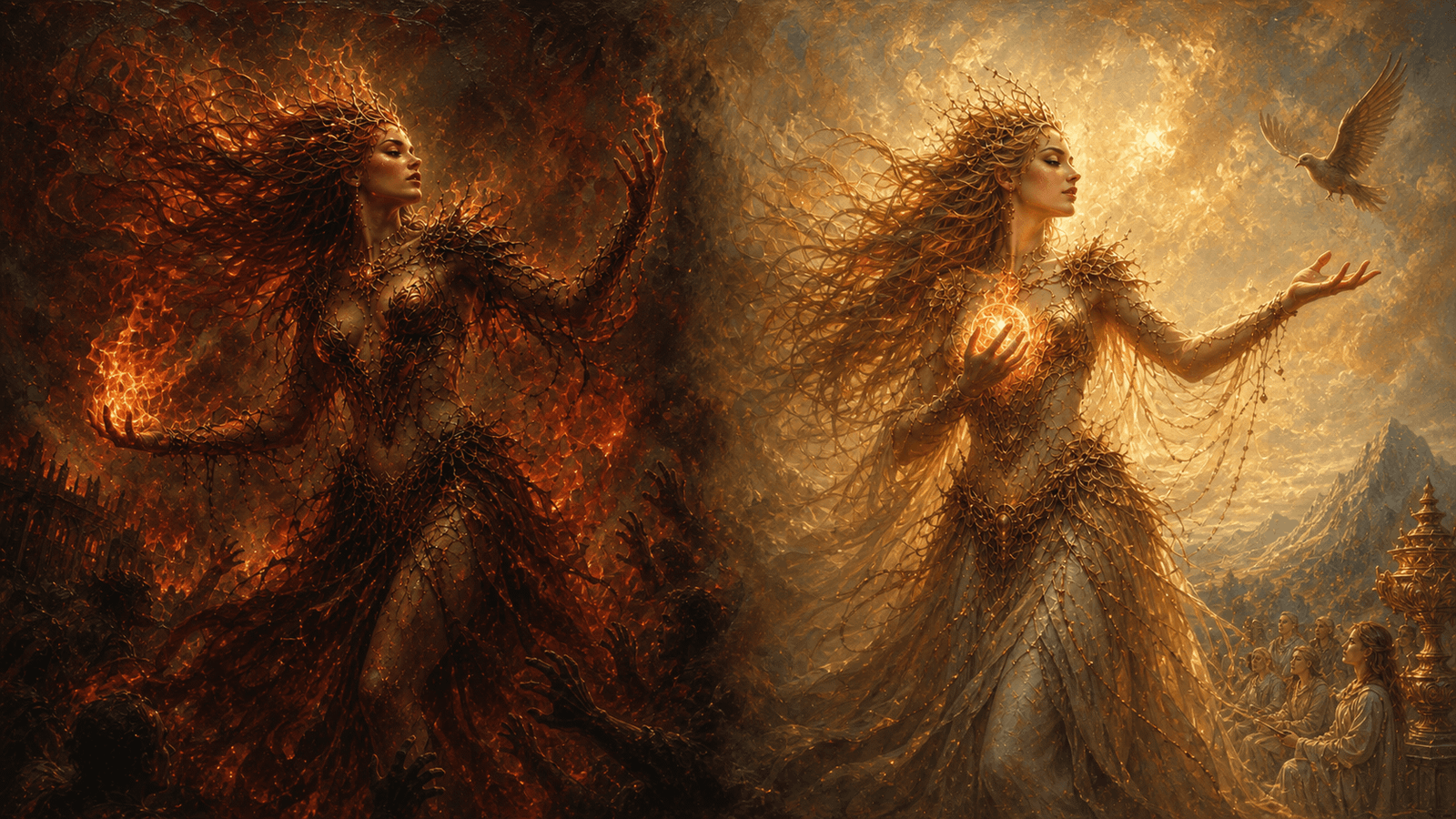
Immature Fire wants immediate proof that it is alive, powerful, desirable, talented, courageous, or important.
It uses action as identity, intensity as authenticity, attention as evidence of impact, and opposition as an opportunity to demonstrate force. It may begin constantly, promise excessively, compete compulsively, and interpret restraint as weakness.
Its deepest fear is not always failure.
It is insignificance.
Immature Fire believes that if it stops moving, expressing, performing, pursuing, or provoking, it may disappear from the awareness of others and eventually from its own awareness.
It therefore seeks experiences capable of producing immediate heat.
Conflict feels alive.
Desire feels alive.
Risk feels alive.
Recognition feels alive.
Ordinary consistency feels dangerously quiet.
Immature Fire wants courage without fear, passion without proportion, drive without rest, determination without adjustment, and strength without accountability.
It can ignite almost anything.
It has not yet learned what deserves to keep burning.
Mature Fire
Mature Fire no longer needs constant intensity to trust that its energy remains present.
It understands that courage includes preparation, passion includes patience, drive includes recovery, and strength includes restraint. It recognises that acting first creates responsibility for what follows.
Mature Fire can move decisively without treating every delay as defeat.
It can express desire without turning desire into entitlement. It can remain powerful while listening, remain visible without demanding the centre, and remain committed without sacrificing everything indiscriminately.
Most importantly, mature Fire chooses.
It asks:
Does this action express courage, or merely discharge discomfort?
Does this passion expand my life, or consume everything outside itself?
Am I pursuing what matters, or proving that I can continue suffering?
Will this use of strength create greater agency, or only make somebody else afraid?
Mature Fire does not merely burn brightly.
It becomes reliable enough that others can approach its warmth without fearing the flame.
What Fire Needs
Fire needs freedom of movement, but not the absence of responsibility.
It requires environments where initiative is possible, effort produces consequence, and personal energy is not continually punished for disturbing passive systems. Without this freedom, Fire may become restless, irritable, rebellious, or internally extinguished.
Fire also needs challenge.
A life without meaningful resistance may leave its strength unused. It functions best when there is something to build, develop, defend, overcome, express, or pursue.
At the same time, Fire needs direction.
Without Light, principles, or clearly chosen values, energy can attach itself to whatever produces immediate intensity. Healthy purpose prevents force from becoming random.
Fire needs recognition, but not worship.
It benefits from being seen accurately, especially when courage, effort, and creativity would otherwise remain invisible. Yet constant praise weakens its ability to act without an audience.
It also needs recovery.
Rest must be treated as part of power rather than the opposite of it. Fire that cannot lower its temperature eventually loses the ability to choose when intensity is useful.
Finally, Fire needs evidence that stillness does not equal disappearance.
It must learn that identity can survive quiet phases, unfinished progress, reduced visibility, and moments when another person holds the centre.
Fire in Relationships
Fire expresses love through visible investment.
It initiates, pursues, protects, celebrates, creates experiences, and brings emotional energy into the relationship. It often shows care by making the other person feel actively chosen rather than passively included.
At its best, Fire makes relationships feel alive.
It encourages expression, play, honesty, physical presence, courage, and shared movement. It may help another person attempt what fear had kept distant or remember the desires buried beneath routine.
However, Fire can struggle when love requires patience without immediate response.
It may interpret quietness as disinterest, caution as rejection, or emotional processing as withdrawal. Its desire to restore heat can create pressure before the other person is ready to move.
Fire also takes indifference personally.
Open disagreement may feel easier to tolerate than emotional absence because conflict still confirms that energy exists between people. A lack of reaction can feel like erasure.
This may lead Fire to provoke when connection feels uncertain.
Intensity is created because intensity feels preferable to invisibility.
In conflict, Fire tends to move directly toward expression.
It wants the issue named, the emotion acknowledged, and the relationship returned to movement. This can prevent resentment from becoming permanent.
It can also overwhelm people who require time to understand what they feel.
The healthiest relationships for Fire allow both passion and regulation.
Desire can be visible, conflict can be honest, and affection can be expressive without requiring every emotional moment to become urgent.
Fire in Work and Creation
Fire is naturally drawn toward work that requires initiative, courage, performance, persuasion, competition, leadership, creativity, rapid decision-making, physical energy, or the ability to generate momentum where none previously existed.
It may appear through entrepreneurship, sport, leadership, performance, activism, sales, emergency work, teaching, creative direction, entertainment, public speaking, military service, coaching, invention, or any role where personal force must enter the environment visibly.
Fire-led creators often begin through fascination.
An image, emotion, idea, conflict, or desire becomes hot enough that expression feels necessary. Their work carries personal presence and often seeks to awaken a response rather than remain emotionally neutral.
They are rarely satisfied with work that merely exists.
They want it to move someone.
As a leader, Fire creates momentum.
It can make decisions, rally people around action, communicate urgency, and help a group move beyond hesitation. Healthy Fire leadership makes courage contagious.
Unhealthy Fire leadership becomes personality-centred.
It demands loyalty to the leader’s energy, creates unnecessary urgency, rewards visible enthusiasm over quiet competence, and interprets questions as resistance.
Fire works best when initiative has direction, intensity has limits, and the person who starts the movement remains willing to support the less dramatic work required to sustain it.
Fire Under Stress
Fire initially responds to stress by increasing action.
It works harder, speaks more directly, moves faster, and attempts to restore agency through visible effort. This can create remarkable effectiveness when hesitation would increase danger.
But when the situation remains unresolved, Fire may become increasingly reactive.
It begins interpreting delay as obstruction, disagreement as challenge, and uncertainty as weakness. The need to act becomes more urgent as control decreases.
If the pressure continues, Fire may burn outward or inward.
Outwardly, it becomes volatile, aggressive, impatient, and destructive.
Inwardly, it becomes exhausted, ashamed, numb, and unable to access the energy upon which identity previously depended.
The person who once acted instinctively may begin avoiding even simple decisions because every remaining spark feels too expensive to use.
Recovery begins by reducing unnecessary combustion.
Not every problem requires maximum effort.
Not every emotion requires immediate expression.
Not every responsibility belongs to the person currently most willing to carry it.
Fire recovers through one meaningful action supported by genuine restoration.
Not forced productivity.
Not dramatic reinvention.
One movement that produces more energy than it consumes.
The Growth Path of Fire
Fire must learn that action is not automatically courage.
It must learn that passion is not possession, intensity is not truth, exhaustion is not proof of commitment, and strength is not the ability to overpower.
A force capable of creating movement must become capable of understanding the movement it creates.
Fire must also surrender the fantasy of endless energy.
The self is not an infinite fuel source. Every commitment consumes something. Every pursuit excludes another possibility. Every act of courage creates consequences that must later be carried.
The purpose of discipline is not to extinguish Fire.
It is to protect Fire from consuming itself.
Fire reaches maturity when it stops asking, “How do I prove that I am powerful?” and begins asking, “What deserves the energy I have to give?”
That shift changes everything.
Impulsiveness becomes courage.
Obsession becomes passion.
Volatility becomes intensity.
Burnout becomes drive.
Overexertion becomes determination.
Aggression becomes strength.
Fire stops treating every spark as a command.
It becomes the living force through which chosen values enter action.
How Fire Differs from Similar Elements
Fire Is Not Nether
Fire creates movement.
Nether creates transformation.
Fire acts because desire, courage, passion, or immediate energy seeks expression. Nether acts because the current form has become incapable of continuing without rupture.
Fire begins the charge.
Nether breaks the structure that prevents the charge from changing anything fundamental.
Without Nether, Fire may act repeatedly without transforming the deeper condition.
Without Fire, Nether may understand what must change while lacking the immediate force required to begin.
Fire Is Not Light
Light determines direction.
Fire generates the force required to move in that direction.
Light asks what matters, what is true, and what deserves protection or pursuit. Fire asks whether the person possesses enough courage and energy to act upon that recognition.
Light can reveal a worthy path.
Fire walks it.
Without Light, Fire may become powerful without knowing what its power should serve.
Without Fire, Light may understand exactly what should happen while remaining unable to create movement.
Fire Is Not Air
Air explores through thought, communication, curiosity, and changing perspective.
Fire explores through direct experience.
Air may imagine several possible actions, discuss their implications, and compare different routes. Fire learns what the route contains by entering it.
Air changes direction when new information appears.
Fire may continue because commitment has already created momentum.
Without Air, Fire may act before understanding enough.
Without Fire, Air may understand indefinitely without allowing knowledge to become consequence.
Balanced Fire
Balanced Fire is courageous without becoming impulsive.
It is passionate without becoming obsessive, intense without becoming volatile, driven without becoming depleted, determined without worshipping suffering, and strong without becoming aggressive.
It moves quickly when speed serves the situation and waits when patience protects the outcome.
It understands that energy has both expression and responsibility. The ability to act does not automatically prove that action is necessary. Desire creates information, not entitlement. Strength creates capacity, not authority over another person’s will.
Balanced Fire does not reduce its brightness to avoid making others uncomfortable.
It also does not demand that every person organise themselves around its heat.
It creates movement that others can join without being consumed by it.
Three Expressions of Fire Through the Zodiac
Fire does not express itself identically through every sign it defines.
In Leo, Fire is illuminated by Light and becomes radiance.
In Sagittarius, Fire is expanded by Aether and becomes pursuit.
In Aries, Fire is intensified by Nether and becomes initiation.
Each sign reveals a different relationship with inner power: Leo becomes the flame, Sagittarius becomes the torch, and Aries becomes the spark.
- Leo is the flame that radiates.
- Sagittarius is the torch that travels.
- Aries is the spark that initiates.
Together, they reveal three essential movements of Fire: becoming visible, becoming expansive, and becoming active.
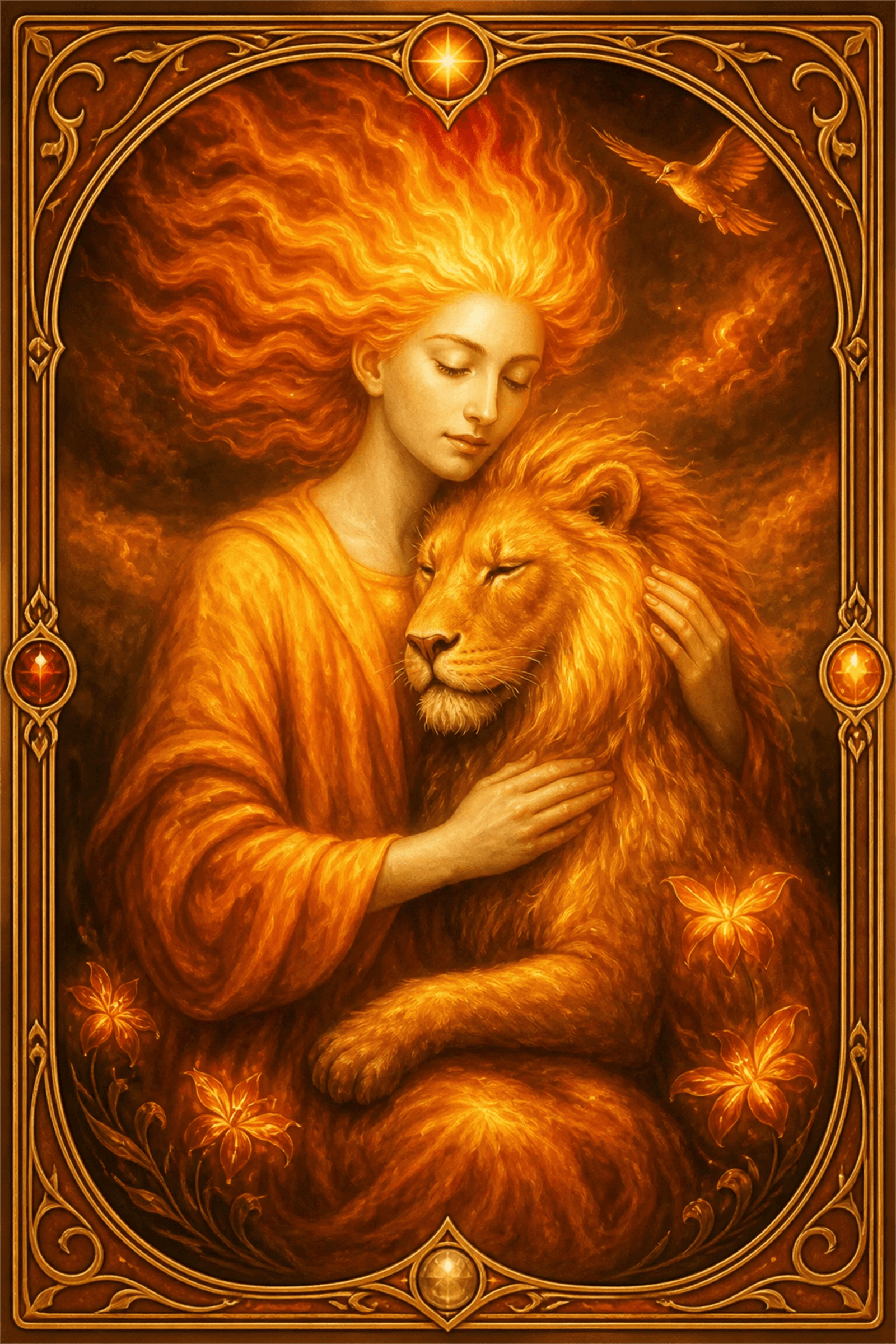
Leo: Light Reveals Fire
In Leo, Fire becomes radiance.
Leo carries Fire through Light—the force of recognition, conviction, integrity, inspiration, and visible meaning. What Fire generates inwardly, Light makes recognisable outwardly.
Leo’s Fire is therefore closely connected to identity.
It does not merely want to act.
It wants action to reveal something real about the person acting.
Creativity becomes self-expression. Courage becomes dignity. Passion becomes presence. Strength becomes the refusal to hide what the self knows it was meant to embody.
Leo burns visibly.
Its Fire gathers around the heart and moves outward through performance, leadership, affection, creativity, style, confidence, and the desire to live in a manner that can be witnessed.
Through Leo, Fire becomes the flame.
A stable source of heat and visibility through which inner life becomes external presence.
At its best, Leo uses Fire to animate others. Its confidence reminds people of their own possibility, its warmth creates belonging, and its visible courage makes self-expression feel less dangerous.
At its worst, radiance becomes performance. Passion depends upon applause, identity depends upon recognition, and the flame begins consuming attention merely to confirm that it remains visible.
Mature Leo does not express itself only to prove that it matters.
It becomes fully present enough that others remember their own presence matters too.
Leo carries Fire outward through visible identity.
Its question is:
What within me deserves to become fully expressed?
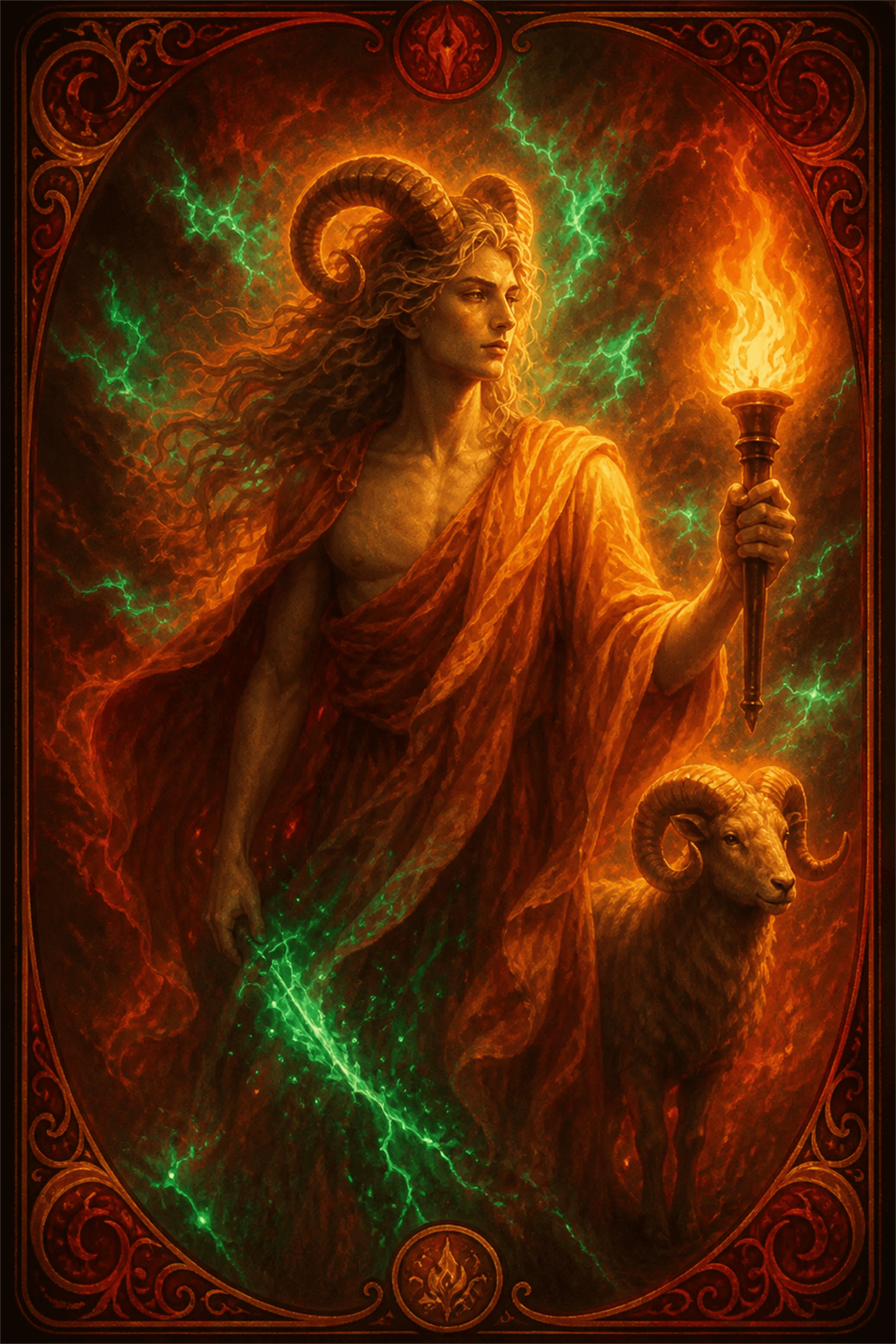
Aries: Nether Intensifies Fire
In Aries, Fire becomes initiation.
Aries carries Fire through Nether—the force of instinct, breakthrough, independence, rebellion, and transformative pressure. What Fire experiences as the desire to move, Nether concentrates into the force required to cross resistance.
Aries does not merely wait for movement to become natural.
It creates the opening through which movement becomes possible.
Its Fire is immediate, embodied, and confrontational. Fear, competition, obstruction, desire, and urgency become fuel for direct action.
Through Aries, Fire becomes the spark.
Small, sudden, and capable of igniting an entire field before the surrounding environment has fully understood what has begun.
This is why Aries often appears most alive at the beginning. The first step, first challenge, first refusal, first risk, and first confrontation activate its elemental nature.
At its best, Aries ends paralysis. It acts before collective hesitation hardens into permanent submission and gives others evidence that the obstacle can be engaged directly.
At its worst, initiation becomes collision. Speed replaces judgment, resistance is treated as insult, and the desire to begin becomes more important than responsibility for what has been set in motion.
Mature Aries does not ignite every conflict merely because it possesses the power to begin one.
It becomes the first movement when movement is genuinely required.
Aries carries Fire directly into resistance.
Its question is:
What must begin now so hesitation no longer controls the outcome?
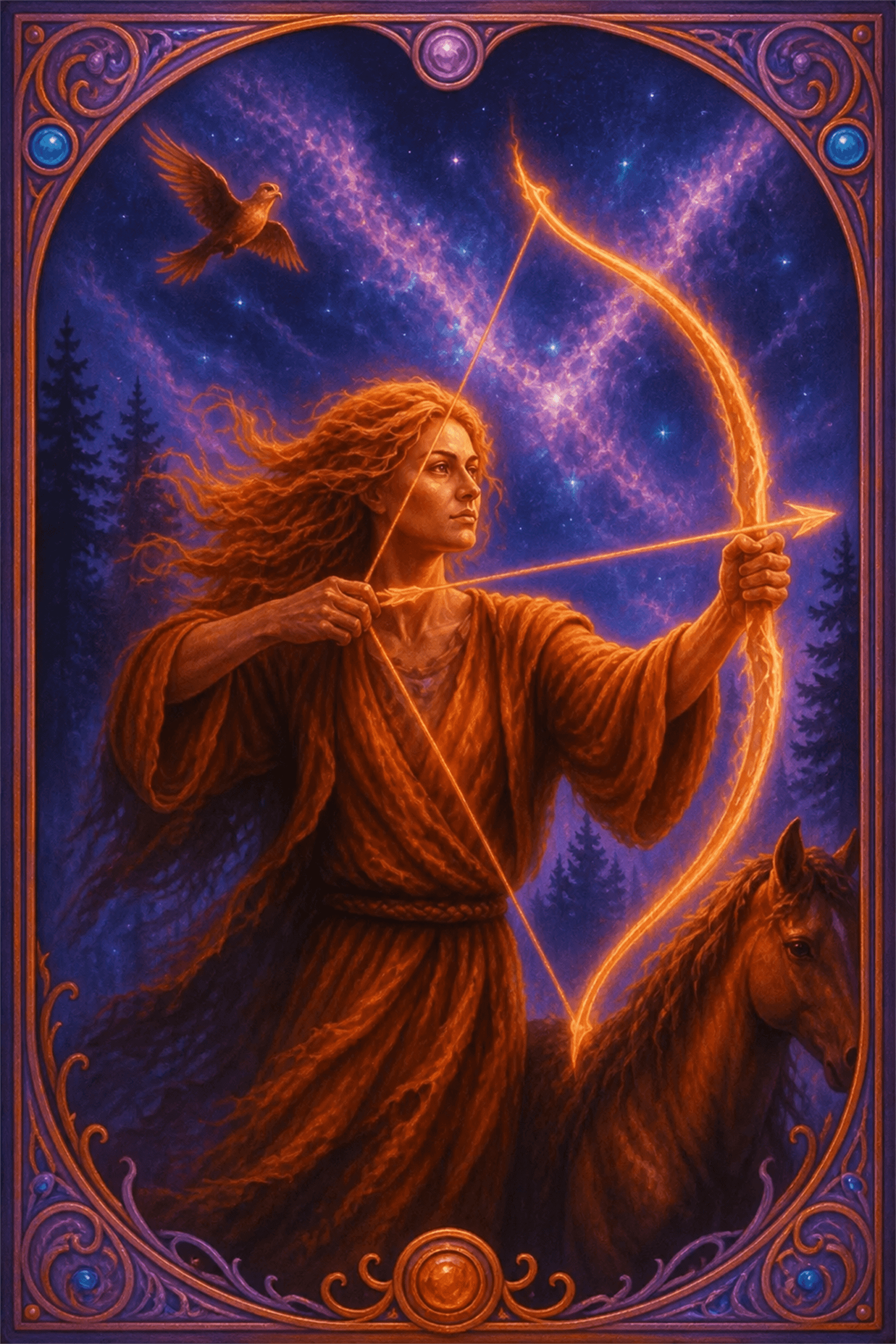
Sagittarius: Aether Expands Fire
In Sagittarius, Fire becomes pursuit.
Sagittarius carries Fire through Aether—the force of intuition, transcendence, imagination, unity, coherence, and possibility beyond present limitation. What Fire experiences as desire, Aether extends toward a horizon larger than immediate circumstance.
Sagittarius’s Fire therefore needs somewhere to travel.
It seeks knowledge, experience, freedom, truth, adventure, culture, belief, and encounters capable of expanding the frame through which life is understood.
Its passion is rarely satisfied with repetition.
It wants movement to reveal a larger world.
Through Sagittarius, Fire becomes the torch.
It illuminates enough of the unknown to continue travelling without requiring the entire path to become visible before the journey begins.
This Fire is sustained by possibility.
A distant goal, unanswered question, unexplored place, or larger meaning gives courage a direction. Sagittarius often acts because remaining still would prevent life from revealing what exists beyond the current boundary.
At its best, Sagittarius spreads enthusiasm for discovery. It gives people courage to question inherited limits, enter unfamiliar territory, and pursue meaning through direct encounter.
At its worst, expansion becomes restlessness. Every commitment feels too narrow, every ordinary responsibility appears beneath the quest, and the next horizon becomes an excuse to abandon what the current journey still requires.
Mature Sagittarius does not move merely because distance feels like freedom.
It carries Fire far enough that experience can return as understanding.
Sagittarius carries Fire toward a larger horizon.
Its question is:
What must I pursue so life can expand beyond its present boundaries?
Symbols of Fire
Fire is symbolically connected with flames, embers, torches, candles, sunlight, hearths, furnaces, sparks, volcanoes, red metal, summer heat, predators, weapons, crowns, hearts, blood, drums, dawn, charging animals, burning forests, and every image through which contained energy crosses into visible movement.
Its symbols are not merely destructive.
They animate.
An ember may appear small while preserving enough heat to begin another fire.
A hearth contains flame so warmth can sustain life rather than consume the home.
A torch carries light and heat into territory that would otherwise remain unreachable.
Fire’s nature is the Ember: inner heat that survives even when outward intensity has lowered.
Its role is the Vanguard: the force willing to move first.
Its absence becomes the Ashbound: a life surrounded by what once burned, unable to recover the spark required to begin again.
Common Misunderstandings About Fire
Fire is not anger.
Anger can activate Fire, but courage, joy, creativity, desire, and love can activate it as well.
Fire is not aggression.
Strength creates the capacity to act. Aggression uses that capacity to remove another person’s freedom.
Fire is not constant confidence.
Courage often acts before confidence has formed.
Fire is not endless productivity.
Drive without recovery becomes burnout.
Fire is not attention-seeking.
Visible self-expression may exist to communicate aliveness rather than demand admiration.
Fire is not selfishness.
Desire becomes selfish only when it treats other people’s agency as irrelevant.
Fire is not Nether.
Fire initiates movement. Nether transforms the structure through rupture.
Fire is the capacity to turn inner energy into courageous, passionate, and consequential action.
Nothing more.
Nothing less.
The Legacy of Fire
Fire is not remembered merely for burning brightly.
Many intense lives create heat without creating anything that survives it.
Its true legacy begins when energy becomes ignition—when one act of courage ends collective hesitation, when passion creates work that awakens other people, when strength protects what could not protect itself, or when a person’s willingness to begin makes another future available.
Fire leaves behind the first step nobody else was willing to take.
The creation that existed because desire became stronger than embarrassment.
The boundary that became action rather than resentment.
The life that stopped waiting for permission.
The courage that became contagious.
Immature Fire wants proof that it is alive.
Mature Fire wants its aliveness to create something worthy of the energy consumed.
That is the final evolution of zeal.
The need for constant heat gives way to sustainable power. Impulse becomes courage. Intensity becomes presence. Passion stops consuming the self and begins animating the world around it.
Fire has completed its work when the movement no longer depends upon the original person continuing to push it.
Others have caught the spark.
What began as inner power has become living momentum.
Learn More About Your Elemental Nature
Your Octa Element Chart reveals the elemental force operating at the centre of your identity, how it expresses when balanced, how it distorts under pressure, and what mastery of that pattern may require.