
Water Element Overview
| Element | Tier | Polarity | Function | Energy Direction | Synergy | Opposition | Zodiac Expressions | Theme | Concept | Mythic Correspondence |
| Water | Core | Feminine | Emotional bonding, depth, continuity | Inward and lateral | Earth | Fire | Cancer: Water + Darkness Pisces: Water + Aether Scorpio: Water + Nether | Emotional Intelligence | Connection | Poseidon (Greek) Gonggong (Chinese) Isis (Egyptian) Ran (Norse) |
The Element of Connection
Water is the power that allows one life to be affected by another.
It moves through emotional boundaries, receives what cannot be understood through distance alone, and creates connection through feeling, memory, empathy, patience, and shared experience. Water governs depth, attunement, sensitivity, flow, intimacy, compassion, adaptation, emotional memory, and the human capacity to recognise that nothing alive exists entirely by itself.
But Water is not sadness, softness, passivity, or emotion in their simplest forms.
It does not exist merely to feel, comfort, forgive, absorb, or remain close. Real Water can nurture connection, but it can also reveal where connection has become dependency. It can adapt, but adaptation without boundaries becomes self-erasure. It can understand pain, but understanding pain does not require permitting the behaviour pain produces.
Water asks an intimate question:
What becomes possible once experience is allowed to move between us?
The Essence of Water
Every element changes reality in a different way.
Fire creates movement. Water creates connection. Air creates understanding. Earth creates structure. Light creates orientation. Darkness creates boundaries. Aether creates resonance. Nether creates transformation.
Water joins.
It allows separate experiences to enter relationship without requiring them to become identical. It carries emotion between people, memory across time, influence through communities, and meaning through bonds that cannot be reduced to logic or transaction.
Where Air understands another person through information, Water understands through attunement.
Where Darkness protects the inner world, Water allows the inner world to be shared.
Where Aether perceives connection across distance, Water experiences connection directly through emotional contact.
This is why Water is deeply connected to emotional intelligence.
Emotional intelligence is not simply having strong feelings or being considerate.
It is the capacity to recognise what is being felt, understand how feeling shapes behaviour, regulate emotional movement, respond to another person without becoming absorbed by them, and preserve connection without abandoning truth.
Water recognises that human beings rarely act from reason alone.
Fear shapes decisions. Shame conceals motive. Grief changes perception. Hope creates endurance. Resentment survives beneath politeness. Love can protect, distort, liberate, or imprison depending upon the form through which it moves.
Water attends to these currents.
It understands that what is unspoken can still influence the entire emotional field. A room may appear calm while everyone adapts around one person’s anger. A relationship may continue while intimacy has already withdrawn. A family may call itself close while every member has learned which truths must remain submerged.
Water notices what moves beneath the visible exchange.
At its highest expression, Water does not merely feel what others feel.
It creates enough emotional movement that what was isolated can enter relationship, be understood, and change form.
How Water Manifests
Water manifests through response.
It enters an emotional field and begins adjusting to what is present. It notices tone, timing, distance, hesitation, warmth, discomfort, and the difference between what has been spoken and what the interaction actually feels like.
Water rarely experiences communication as words alone.
A silence has texture. A gesture changes meaning according to context. A familiar sentence feels different when spoken with restraint, fear, tenderness, or contempt. The same behaviour can express care, obligation, avoidance, or control depending upon the emotional current beneath it.
This does not mean Water always interprets these signals correctly.
It means Water is naturally compelled to receive them.
Where Fire enters a situation and changes its momentum, Water enters and senses its condition. Where Earth looks for what remains stable, Water notices what is already shifting. Where Air may separate emotion from analysis, Water recognises that emotion is itself a form of information.
Its movement is therefore both receptive and adaptive.
Water takes the shape of what contains it, but it does not become identical to the container. It responds to terrain, pressure, temperature, and obstruction while preserving its essential capacity to move.
This is why Water can appear gentle in one environment and powerful in another.
A stream moves around stone.
A tide reshapes the shore.
Rain nourishes.
Floodwater removes the structure that refused to respect its force.
Water does not possess only one emotional intensity.
It possesses range.
The Inner Experience of Water
To experience life through Water is to feel that relationships create internal consequence.
Another person’s joy can awaken joy. Their withdrawal can create uncertainty. Their suffering can remain emotionally present long after the interaction has ended. A memory can return with the force of a current because emotional time does not always move in a straight line.
Water often experiences feeling before explanation.
The body recognises tension. The heart withdraws. Compassion rises. Grief appears before the conscious mind has accepted that something has been lost.
This creates a strong relationship with emotional truth, but not necessarily with emotional certainty.
Emotional truth means the feeling exists and deserves recognition.
Emotional certainty assumes the feeling’s first interpretation must be correct.
Water may know that something feels unsafe before understanding why. It may also feel abandoned when another person is merely tired, rejected when a boundary is necessary, or responsible for pain it did not create.
The feeling is real.
Its explanation still requires examination.
Water often carries emotional memory deeply. It remembers not only what happened, but how the event altered the relationship. A forgotten promise may matter less for the practical failure than for the message it appeared to communicate. A moment of protection may remain meaningful because it changed the person’s understanding of what safety could feel like.
This inner world can create profound intimacy and compassion.
It can also create emotional saturation.
The Water-oriented person may struggle to distinguish what belongs to them from what has been absorbed from others. They may carry moods, needs, grief, and expectations long after direct contact has ended.
At its best, Water makes experience shareable.
At its worst, it loses its own shape inside what it receives.

The Gifts of Water
Depth
Water moves beneath surface appearance.
It recognises that behaviour often contains histories, needs, fears, and contradictions that cannot be understood through immediate judgment alone. This makes Water valuable in relationships, psychology, healing, art, caregiving, conflict, and every moment where the visible event is only the upper layer of what is actually happening.
Its depth is not merely seriousness.
It is emotional dimensionality.
Water can hold several realities at once. A person may love someone and still need to leave them. An apology may be sincere while remaining insufficient. A painful reaction may be understandable without becoming acceptable.
Depth allows Water to resist simple conclusions when life has produced a more complicated truth.
It does not automatically excuse what it understands.
It ensures that understanding reaches far enough to become meaningful.
Patience
Water allows processes to unfold at the speed required by emotional reality.
It understands that trust cannot always be demanded, grief cannot be scheduled, vulnerability cannot be forced, and healing may continue long after the external crisis appears resolved.
Patience allows Water to remain present without making another person’s pace feel like personal rejection.
It can listen without rushing toward solution, wait without withdrawing care, and recognise that pressure often closes what safety might eventually open.
Healthy patience is not endless tolerance.
It does not wait forever for someone who repeatedly refuses responsibility.
It gives genuine process enough time to reveal whether movement is occurring.
Attunement
Water recognises the emotional condition of the moment.
It notices subtle changes in tone, behaviour, presence, and relational distance. It can sense when someone needs comfort, space, reassurance, honesty, protection, or a conversation that has been avoided.
Attunement allows Water to respond proportionately rather than mechanically.
The same words may help one person and wound another. The same truth may need directness in one moment and gentleness in another. The same silence may be supportive or abandoning depending upon what the relationship requires.
Healthy attunement does not become mind-reading.
It observes, senses, and then checks.
Water becomes trustworthy when it can say:
This is what I am noticing. Is that what is happening?
Empathy
Water enters another person’s emotional reality without requiring direct personal experience of the same event.
It can understand pain it has not lived, recognise needs it does not share, and temporarily experience the world through another person’s position.
Empathy allows connection to survive difference.
It prevents unfamiliarity from becoming indifference and makes care possible beyond the limits of personal identification.
Healthy empathy does not eliminate accountability.
Understanding why someone caused harm does not erase the harm. Recognising trauma does not require surrendering one’s boundaries to its consequences.
Empathy becomes mature when it can remain compassionate without making compassion dependent upon continued access.
Sensitivity
Water receives what stronger filters might exclude.
It notices beauty, discomfort, tension, tenderness, rejection, symbolism, and emotional detail that others may overlook. This sensitivity can deepen creativity, intimacy, moral awareness, and the capacity to recognise suffering before suffering becomes publicly visible.
Sensitivity is not weakness.
It is permeability.
A sensitive system registers more.
That increased reception requires greater regulation, not shame.
Healthy sensitivity allows Water to remain responsive without allowing every stimulus to determine its entire state. It learns which signals deserve action, which require rest, and which belong to someone else.
Flow
Water moves with changing conditions.
It adapts, releases, redirects, and discovers another path when the first route closes. This makes Water capable of surviving environments where rigidity would create breakdown.
Flow does not mean lacking commitment.
It means remaining responsive enough that commitment can continue through changing form.
A conversation may need another approach. A relationship may need new boundaries. A goal may require a slower pace. A former identity may need to be released because life has moved beyond it.
Healthy flow does not surrender direction.
It accepts that direction and form are not always the same thing.
Water reaches the destination not by refusing every obstacle, but by allowing obstacles to reveal another route.

The Inversion of Water
Every elemental gift becomes dangerous when connection loses boundaries.
Water’s inversion begins when receptivity becomes so complete that it can no longer distinguish empathy from absorption, patience from surrender, or adaptation from self-abandonment.
Depth Becomes Shallowness
Distorted Water may appear deeply emotional while repeatedly avoiding the actual emotional truth.
It can generate intense reactions, dramatic disclosures, symbolic interpretations, and endless conversations without entering the more difficult layer beneath them.
The person may speak constantly about feelings while remaining unable to name the central need, fear, responsibility, or pattern.
Intensity substitutes for depth.
Every emotional wave feels significant because it is strong, not because it has been understood.
Shallowness is not the absence of feeling.
It is feeling that never descends far enough to transform understanding.
Patience Becomes Passivity
Patience becomes passivity when waiting replaces choice.
Distorted Water may remain inside harmful situations, tolerate repeated violations, and delay necessary action because it hopes time will produce a change nobody is actively creating.
The person interprets endurance as love and inaction as compassion.
They continue waiting for accountability, clarity, commitment, or safety long after the pattern has revealed itself.
Healthy patience allows a process to unfold.
Passivity allows the process to decide everything.
Attunement Becomes Disconnection
Attunement becomes disconnection when Water loses reliable contact with the emotional field.
This can happen through overwhelm, chronic invalidation, defensive numbness, or repeated environments where sensitivity was punished.
The person may stop recognising their own feelings, misread others, or withdraw from emotional signals because receiving them has become too exhausting.
Alternatively, they may become so focused on one expected emotional pattern that they stop noticing what is actually present.
Disconnection is not emotional neutrality.
It is the loss of contact through which response becomes possible.
Empathy Becomes Apathy
Empathy becomes apathy when emotional capacity has been depleted, defended, or narrowed until another person’s experience no longer produces meaningful response.
Distorted Water may become indifferent, dismissive, or emotionally unavailable after carrying too much for too long. It can treat vulnerability as inconvenience because vulnerability now threatens demands the person no longer has the strength to meet.
Apathy may appear cold.
It often begins as exhausted sensitivity.
The system stops responding because response has repeatedly required more than it could sustainably give.
Healthy empathy includes limits.
Without limits, empathy may eventually consume the conditions that allow it to exist.
Sensitivity Becomes Martyrdom
Sensitivity becomes martyrdom when suffering becomes proof of goodness.
Distorted Water may repeatedly sacrifice its own needs, remain available beyond capacity, and tolerate harm because being the one who understands, forgives, or carries everything has become central to identity.
The person may resent the people they continue rescuing while remaining unable to stop. Their pain becomes evidence that their love is deeper, their morality greater, or their role indispensable.
Martyrdom does not merely give too much.
It creates emotional authority through having given too much.
Healthy sensitivity recognises suffering.
Martyrdom needs suffering to justify its identity.
Flow Becomes Stagnation
Flow becomes stagnation when adaptation prevents decisive movement.
Distorted Water may reshape itself around the same obstacle indefinitely. It changes expectations, reduces needs, finds new explanations, and becomes increasingly flexible while the situation itself remains unchanged.
The person appears to be moving emotionally.
Their life remains in the same place.
Stagnation can feel like flow because internal states continue shifting. Hope rises, disappointment falls, forgiveness returns, and another cycle begins.
Real flow carries something forward.
Stagnation moves in circles.
Signs Your Life Lacks Water
A life lacking Water does not always appear lonely.
It may remain social, productive, intelligent, independent, and surrounded by people while quietly losing emotional depth, intimacy, empathy, and the ability to be genuinely affected.
The absence of Water is not simply emotional restraint.
It is the loss of a healthy relationship with feeling, connection, receptivity, vulnerability, adaptation, and the shared reality through which human beings become more than isolated individuals.
You may still interact constantly.
Nothing truly reaches you.

You Can Explain Every Feeling but Cannot Experience It
Without Water, emotion may become purely intellectual.
You know the correct psychological language. You can identify attachment patterns, trauma responses, communication styles, and relational dynamics while remaining disconnected from the physical and emotional experience beneath the analysis.
Understanding becomes distance.
You describe the feeling instead of entering it.
This can create the appearance of emotional intelligence without the vulnerability required for emotional contact.
Water returns when the question changes from:
What does this feeling mean?
to:
What does this feeling actually feel like while it is here?
Other People’s Pain Feels Irritating or Inconvenient
A lack of Water can make vulnerability appear inefficient.
You may respond to grief with solutions, fear with criticism, or sadness with impatience because another person’s emotional state interrupts the preferred rhythm of the interaction.
Their pain creates pressure you do not know how to hold.
Rather than admitting discomfort, you treat the emotion as the problem.
Not every emotional demand is reasonable.
But connection weakens when every difficult feeling must become smaller before it is allowed to remain near you.
You Cannot Ask for Comfort
You may express problems while avoiding need.
You explain what happened, make jokes, minimise the impact, or ask for practical help without admitting that you want reassurance, closeness, tenderness, or simple presence.
Need feels dangerous because it gives another person the power to respond inadequately.
Self-sufficiency protects against disappointment.
It also prevents care from becoming mutual.
Water allows a person to say:
I do not need you to fix this. I need not to carry it alone for a moment.
Your Relationships Remain Functional but Emotionally Thin
You may coordinate responsibilities, share activities, communicate regularly, and avoid major conflict while knowing very little about what the other person is experiencing internally.
The relationship works.
It does not deepen.
Conversations remain practical, humorous, intellectual, or habitual. Vulnerability appears only during crisis, then disappears once stability returns.
Connection requires more than continued contact.
Water asks whether both people can affect and be affected without needing an emergency to make emotional truth permissible.
You Treat Sensitivity as Weakness
Without Water, emotional response may be judged according to its usefulness.
Crying appears irrational. Hurt appears oversensitive. Fear appears cowardly. The need for reassurance appears immature.
You may respect people only when their pain remains invisible.
This creates relationships where everyone must become less human in order to remain respectable.
Sensitivity can become dysregulated.
But the answer is not emotional deadness.
It is the development of enough capacity that feeling can be received without governing everything.
You Cannot Remain Present with Discomfort
Another person begins crying, expressing anger, admitting shame, or describing grief, and you immediately try to end the emotional state.
You reassure too quickly, change the subject, provide advice, challenge the interpretation, or withdraw.
The goal becomes emotional closure.
But some feelings need witness before they need resolution.
Water does not require you to absorb another person’s distress.
It teaches you that discomfort can remain in the room without becoming a command to escape.
You Have Forgotten What You Need
A lack of Water can disconnect you from internal signals.
You recognise hunger only once exhausted, loneliness only once resentful, sadness only once numb, and overwhelm only after anger has become difficult to contain.
Needs remain invisible until they become emergencies.
This often happens when emotional awareness was treated as selfish, dramatic, or inconvenient.
Water restores contact before the need must become a crisis to earn recognition.
You Struggle to Adapt When Plans Change
Without Water, disruption may feel like personal violation.
A changed schedule, altered relationship, unexpected mood, or new circumstance produces disproportionate frustration because the internal system depends upon reality remaining as anticipated.
Flexibility feels like losing control.
Yet life changes continuously.
Water does not remove the need for reliability.
It develops enough internal movement that change does not automatically become collapse.
You Cannot Forgive Ordinary Human Imperfection
A lack of Water may make every failure feel conclusive.
One disappointing response proves that the person does not care. One mistake reveals their entire character. One emotionally clumsy moment removes the possibility of repair.
Discernment matters.
Some patterns should end relationships.
But without Water, judgment cannot remain connected to context, growth, remorse, or the possibility that people can act badly without becoming entirely reducible to the act.
Forgiveness does not require continued access.
It requires recognising that human beings are larger than one frozen moment.
You Feel Ashamed of Being Affected
You may believe emotional impact means another person has gained power over you.
You hide disappointment, attachment, jealousy, grief, and tenderness because needing anything from the relationship feels humiliating.
Detachment becomes self-protection.
But being affected is not the same as being controlled.
Connection means allowing another life to matter enough that its presence and absence create consequence.
The goal is not invulnerability.
It is retaining agency while remaining reachable.
You Cannot Receive Care
When someone offers support, you minimise the problem, redirect attention toward them, reject the gesture, or feel immediate pressure to repay it.
Receiving feels more dangerous than giving because receiving reveals dependence.
But care that can move only in one direction is not mutual connection.
It is a role.
Water integrates when giving and receiving can alternate without either person becoming permanently indebted or permanently necessary.
Nothing Moves Through You
The deepest absence of Water is emotional immobility.
Grief remains frozen. Anger remains compressed. Love remains unexpressed. Memory remains unprocessed. The person continues functioning while the inner life becomes increasingly dry.
This may look stable.
It is often preservation without renewal.
Water returns when one contained experience is allowed to move through language, tears, movement, art, conversation, ritual, or simple acknowledgement.
Feeling does not need to disappear.
It needs somewhere to go.
How to Integrate and Master Water
Water is not mastered by becoming endlessly compassionate, emotionally expressive, available to everyone, or willing to absorb every feeling in the room.
It is mastered by building a disciplined relationship with connection.
Integration begins when feeling stops being either suppressed or treated as unquestionable authority. You learn to enter depth without drowning, wait without surrendering agency, attune without mind-reading, empathise without absorbing, remain sensitive without becoming a martyr, and adapt without losing direction.
Mastery does not mean feeling less.
It means becoming capable of feeling fully without allowing feeling to erase the self carrying it.
Name the Feeling Before Explaining It
Move from interpretation to direct recognition.
Instead of beginning with the story, identify the emotional state.
Angry.
Afraid.
Ashamed.
Lonely.
Relieved.
Jealous.
Tender.
Disappointed.
Several feelings may coexist.
Naming does not solve the experience.
It gives the experience enough form to be examined.
Water becomes easier to regulate once emotion is no longer an unnamed atmosphere controlling the entire inner world.

Locate Emotion in the Body
Feeling is not purely conceptual.
Notice pressure, warmth, heaviness, restlessness, contraction, numbness, or changes in breath.
The body may register what the mind is still avoiding.
Ask what happens when the feeling is allowed to exist physically without immediate action or explanation.
This creates a small distance between emotion and behaviour.
The feeling remains present.
It no longer needs to become an impulse merely to prove that it exists.
Separate Feeling from Fact
Emotions contain information.
They are not complete evidence.
Feeling abandoned does not automatically prove abandonment. Feeling unsafe does not always mean immediate danger. Feeling guilty does not always mean you acted wrongly.
At the same time, the absence of proof does not make the feeling meaningless.
Ask:
What happened?
What did I feel?
What meaning did I assign?
What evidence supports that meaning?
What else may be true?
This preserves emotional truth without allowing interpretation to become unquestionable.
Ask Before Assuming
Attunement is strengthened through verification.
You may notice that someone appears distant, tense, disappointed, or uncomfortable. Rather than constructing the entire explanation internally, ask with enough openness that the answer can differ from your expectation.
You seem quieter than usual. Is something happening?
I may be reading this incorrectly, but that sounded painful.
Do you need comfort, space, or help thinking through it?
Healthy Water does not need to prove that its emotional perception was correct.
It wants the connection to become clearer.
Practise Receiving Without Immediate Repayment
Allow another person to help, listen, comfort, or give without instantly reducing the vulnerability through repayment.
Say thank you.
Let the care remain.
Notice the discomfort of receiving and the stories attached to it. You may fear dependence, debt, pity, weakness, or loss of control.
Receiving does not make you permanently dependent.
It allows connection to become reciprocal rather than performative.
Create Emotional Boundaries
Ask what belongs to you and what belongs to the other person.
You can care about someone’s sadness without becoming responsible for removing it. You can understand anger without accepting mistreatment. You can recognise disappointment without reversing every boundary that caused it.
A boundary does not stop emotional contact.
It gives contact a shape.
Without a shoreline, Water does not become more loving.
It becomes a flood.
Let Patience Include a Decision Point
Waiting should have conditions.
What evidence would show that change is occurring?
How long are you willing to remain in the current uncertainty?
Which behaviour cannot continue during the process?
What action will you take if nothing changes?
This prevents patience from becoming indefinite postponement.
Compassion can provide time.
Self-respect determines what the time is for.
Express Needs Before Resentment Expresses Them
Do not assume care should make your needs obvious.
State what you require clearly enough that another person can respond consciously.
You may need reassurance, consistency, space, affection, help, honesty, repair, or changed behaviour.
A hidden need often becomes a hidden test.
When the other person fails the test they did not know existed, resentment presents the failure as proof that they never cared.
Water becomes mature when connection depends less upon being intuitively guessed and more upon honest emotional communication.
Let Grief Move at Its Own Pace
Do not demand immediate meaning from loss.
Grief may change form repeatedly. It can appear as sadness, anger, relief, numbness, nostalgia, guilt, or the sudden return of ordinary memory.
Allow movement without creating a deadline for emotional completion.
At the same time, notice whether grief is moving or only repeating.
Support, ritual, therapy, conversation, creativity, and changes in routine can help the experience acquire another relationship with life.
Water does not erase what was lost.
It carries the loss forward without allowing it to remain the only current.
Protect Sensitivity Through Regulation
Reduce unnecessary emotional exposure.
Rest after intense social contact. Limit access to media or environments that repeatedly dysregulate you. Create routines that return attention to the body and present moment.
Sensitivity requires maintenance.
Do not shame yourself for registering more.
Develop the structures that allow increased reception to remain useful rather than overwhelming.
The goal is not to become less sensitive.
It is to become less defenceless against everything sensitivity receives.
Allow Relationships to Change Form
Connection does not always need to remain in its original structure.
A friendship may require greater distance. A family relationship may need boundaries. A romantic bond may end while respect survives. Care can remain real even when access changes.
Water becomes stagnant when it treats continuity as the only proof that love existed.
Sometimes flow preserves meaning by allowing the form to change.
Release does not automatically invalidate attachment.
It may be the final act through which attachment stops causing harm.
Develop a Self Outside Every Relationship
Maintain desires, routines, friendships, values, and forms of meaning that do not depend entirely upon one bond.
Connection should enrich identity.
It should not become the only environment in which identity can survive.
Ask who you are when nobody needs you, reassures you, chooses you, or reflects you back to yourself.
Water becomes stronger when it can join deeply without requiring merger to feel secure.
Move Emotion Through Expression
Some feelings cannot be solved through thought alone.
Use speech, writing, movement, music, art, tears, ritual, physical activity, or another form that allows emotional energy to change state.
Expression should not become uncontrolled discharge onto other people.
Choose a form capable of carrying what exists without causing unnecessary damage.
Water heals through movement.
What remains trapped begins shaping behaviour from beneath awareness.
Balance Empathy with Accountability
Understand the cause.
Name the consequence.
Hold both.
You can recognise that someone acted from fear while still requiring repair. You can understand their history without becoming responsible for compensating for it. You can offer compassion while removing access.
Empathy becomes stronger when it no longer depends upon denial.
Water does not need to pretend harm was acceptable in order to remain humane.
Measure Mastery Through Mutual Connection
The clearest sign that Water is becoming integrated is not that you feel more intensely or help more people.
It is that connection becomes increasingly reciprocal, honest, and sustainable.
You can remain close without losing your shape.
You can receive care without shame.
You can feel another person’s pain without making yourself responsible for their entire life.
You can wait without abandoning choice.
You can forgive without returning to danger.
You can adapt without betraying what matters.
Water is mastered when emotion moves through you without carrying you away from yourself.
Connection becomes a current between distinct lives rather than the disappearance of one inside another.

Immature Water
Immature Water wants to be needed, understood, protected, emotionally chosen, or impossible to abandon.
It uses feeling as proof, sacrifice as identity, closeness as security, and emotional intensity as evidence that a bond must be meaningful.
It may adapt excessively, test relationships indirectly, expect needs to be sensed without being spoken, or become attached to people whose instability guarantees constant emotional involvement.
Its deepest fear is not always loneliness.
It is emotional irrelevance.
Immature Water believes that if nobody needs its empathy, comfort, patience, or sacrifice, it may no longer possess a clear role in the relationship.
It therefore confuses being necessary with being loved.
It wants intimacy without boundaries, empathy without exhaustion, patience without decision, sensitivity without regulation, and connection without the risk of separation.
Immature Water can feel everything in the room.
It has not yet learned which feelings belong in its body.
Mature Water
Mature Water no longer needs to dissolve in order to prove that connection is real.
It understands that empathy can coexist with refusal, patience with consequence, sensitivity with strength, and attachment with the freedom to leave.
Mature Water can enter another person’s emotional reality without replacing its own. It can offer comfort without becoming responsible for permanent rescue. It can recognise pain without romanticising suffering.
It understands that depth is not measured by how much hurt a person can tolerate.
It is measured by how honestly experience can be understood and transformed.
Most importantly, mature Water remains distinct.
It asks:
Am I responding to what is present, or to what I fear this feeling means?
Does this patience support growth, or protect stagnation?
Am I helping because care is freely chosen, or because being needed protects me from abandonment?
Can this relationship survive both closeness and boundary?
Mature Water does not merely create emotional connection.
It creates connection safe enough that both people can remain whole.
What Water Needs
Water needs emotional safety, but not protection from every difficult feeling.
It requires relationships where vulnerability is not mocked, exploited, minimised, or turned into evidence of weakness. Without this safety, Water may become guarded, indirect, emotionally volatile, or excessively adaptive.
Water also needs response.
Its sense of connection weakens when emotion continually enters a relationship and receives nothing back. Silence, indifference, inconsistency, and chronic emotional unavailability can make Water question whether the bond exists beyond its own investment.
At the same time, Water needs boundaries.
Without limits, empathy becomes absorption, care becomes duty, and patience becomes permission. Healthy boundaries allow emotional connection to remain voluntary.
Water needs time.
It processes experiences through feeling, memory, and relationship. Immediate conclusions may arrive before the emotional meaning has fully settled.
It also needs movement.
Feelings that cannot be expressed, metabolised, or carried into changed behaviour become stagnant. Conversation, art, rest, physical movement, and safe emotional release help restore flow.
Finally, Water needs evidence that separation does not automatically erase connection.
Distance, disagreement, privacy, and independence can exist without abandonment.
Water matures when closeness becomes secure enough to permit space.
Water in Relationships
Water expresses love through emotional presence.
It listens, remembers, adapts, reassures, comforts, and notices what another person may not yet know how to say. It often shows care by entering the emotional reality of the relationship rather than remaining outside it as an observer.
At its best, Water makes people feel accompanied.
Pain does not need to be hidden before connection becomes available. Joy can be shared without competition. Vulnerability does not automatically reduce dignity.
Water often remembers emotional detail.
The sentence spoken during fear. The preference someone mentioned once. The anniversary of a loss. The moment a person withdrew before they admitted they were hurt.
These details become part of how Water protects intimacy.
However, Water can struggle when love requires detachment from another person’s state.
It may feel responsible for restoring every mood, preventing every disappointment, or preserving connection even when mutuality has disappeared.
It can mistake another person’s distress for proof that its boundary was cruel.
Water also takes emotional indifference seriously.
Arguments may hurt, but coldness can feel like relational disappearance. It may prefer painful intensity to emotional absence because intensity still confirms that connection exists.
In conflict, Water seeks emotional recognition.
It wants not only the facts addressed, but the impact understood. An apology that names the action without acknowledging what the action communicated may feel incomplete.
Yet Water must learn that impact does not reveal intention automatically.
The healthiest relationships for Water allow emotion to be real without becoming the only authority.
Both people can feel deeply, communicate directly, repair honestly, and retain the freedom to disagree without making disagreement equivalent to abandonment.
Water in Work and Creation
Water is naturally drawn toward work that requires empathy, observation, patience, emotional communication, adaptation, care, memory, or the ability to understand human needs beneath visible behaviour.
It may appear through psychology, counselling, medicine, nursing, social work, education, art, writing, music, hospitality, mediation, community work, design, caregiving, diplomacy, human resources, research, or any role where people cannot be understood as functions alone.
Water-led creators often work through emotional atmosphere.
They may begin with a memory, mood, relationship, wound, longing, or experience that lacks adequate language. Their work creates a form through which emotion can become shareable.
They are rarely satisfied with technical correctness alone.
They want the work to feel alive.
As a leader, Water creates cohesion.
It notices morale, conflict, exclusion, emotional fatigue, and the unspoken realities affecting performance. Healthy Water leadership understands that people work inside emotional systems even when the organisation prefers to describe everything as process.
Unhealthy Water leadership becomes enmeshed.
It avoids necessary accountability to preserve harmony, rewards emotional closeness over competence, or becomes so responsive to every feeling that direction disappears.
Water works best when care has boundaries, emotional information informs decisions without controlling them, and connection supports rather than replaces clear responsibility.
Water Under Stress
Water initially responds to stress by increasing attunement.
It monitors tone, relationships, risk, and the emotional state of everyone involved. This can create remarkable sensitivity during crisis because Water notices subtle needs and tensions before they become explicit.
But when the situation remains unresolved, Water may become increasingly saturated.
Every change in mood feels significant. Boundaries weaken. The person begins carrying everyone’s distress while losing contact with their own central state.
If the pressure continues, Water may flood or freeze.
Flooding appears as crying, panic, emotional volatility, overdisclosure, pleading, resentment, or desperate attempts to restore connection.
Freezing appears as numbness, withdrawal, apathy, and the sense that nothing can be felt safely because every feeling demands too much.
Recovery begins by reducing the emotional field.
Not everyone’s needs.
One need.
Not the entire relationship.
One honest conversation.
Not every possible interpretation.
One feeling that can be named without becoming a verdict.
Water recovers by restoring movement within a boundary.
Not suppressing the current.
Not allowing it to cover everything.
Giving it a channel.
The Growth Path of Water
Water must learn that connection is not the same as merger.
It must learn that empathy is not responsibility for another person’s choices, patience is not endless permission, sensitivity is not proof of fragility, and adaptation is not the abandonment of personal direction.
A force capable of entering another person’s emotional reality must become equally capable of returning to its own.
Water must also surrender the fantasy that enough love can prevent every loss.
People change. Relationships end. Needs conflict. Care is not always reciprocated. Understanding does not guarantee repair.
The purpose of emotional intelligence is not to remove pain from connection.
It is to remain capable of connection without allowing pain to erase judgment, boundary, or identity.
Water reaches maturity when it stops asking, “How do I keep this bond from changing?” and begins asking, “What form of connection remains honest, mutual, and alive?”
That shift changes everything.
Shallowness becomes depth.
Passivity becomes patience.
Disconnection becomes attunement.
Apathy becomes empathy.
Martyrdom becomes sensitivity.
Stagnation becomes flow.
Water stops proving love through how much it can absorb.
It becomes the emotional current through which separate lives can meet without losing their shores.
How Water Differs from Similar Elements
Water Is Not Darkness
Water creates connection.
Darkness creates boundaries.
Water opens emotional exchange, enters shared experience, and allows separate inner worlds to affect one another. Darkness protects what requires privacy, containment, and selective access.
Water invites intimacy.
Darkness determines when intimacy is safe.
Without Darkness, Water can become emotionally flooded, exposed, or enmeshed.
Without Water, Darkness can protect the inner world so completely that nothing living can enter or leave it.
Water Is Not Aether
Water experiences connection through emotion, memory, empathy, and direct attunement.
Aether perceives connection through resonance, possibility, symbolism, and larger patterns that may extend beyond immediate personal experience.
Water enters the feeling of the particular person.
Aether recognises the field connecting many people, ideas, or realities.
Without Aether, Water may become absorbed in the immediate bond and lose the wider perspective.
Without Water, Aether may speak of universal unity while remaining emotionally absent from the person directly beside it.
Water Is Not Nether
Water adapts around resistance.
Nether confronts the point where resistance must be broken or transformed.
Water heals through emotional movement, patience, connection, and the ability to carry experience into another form.
Nether heals through rupture, endings, pressure, and the destruction of conditions that prevent transformation.
Water asks what can still move between us.
Nether asks whether the current form must end.
Without Nether, Water may continue adapting to what should have been confronted.
Without Water, Nether may force change without processing the emotional consequences that shape what follows.
Balanced Water
Balanced Water is deep without becoming consumed by complexity.
It is patient without becoming passive, attuned without becoming hypervigilant, empathic without becoming depleted, sensitive without becoming self-sacrificing, and adaptable without becoming stagnant.
It feels fully while remaining capable of examination.
It understands that emotions have both truth and limitation. A feeling reveals an internal reality, but not necessarily the complete external one. Empathy creates understanding, but not automatic permission. Connection creates responsibility, but not ownership.
Balanced Water does not avoid attachment because attachment creates vulnerability.
It also does not use attachment to justify the loss of identity.
It allows connection to move between distinct people.
Three Expressions of Water Through the Zodiac
Water does not express itself identically through every sign it defines.
In Cancer, Water is contained by Darkness and becomes sanctuary.
In Pisces, Water is expanded by Aether and becomes communion.
In Scorpio, Water is transformed by Nether and becomes metamorphosis.
Each sign reveals a different relationship with emotional connection: Cancer becomes the tidepool, Pisces becomes the ocean, and Scorpio becomes the undertow.
Together, they reveal three essential movements of Water: connection protected, connection expanded, and connection transformed.
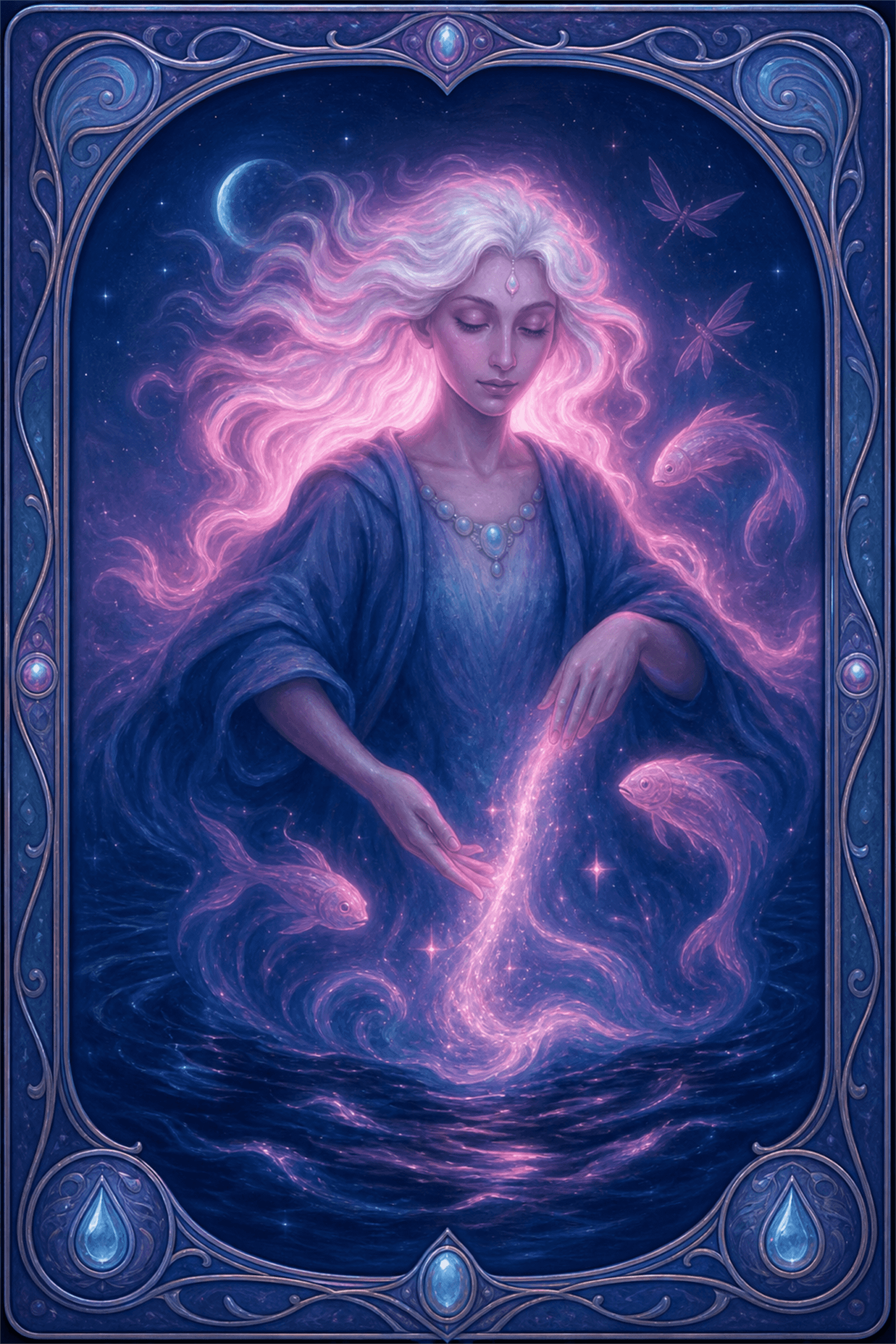
Pisces: Aether Expands Water
In Pisces, Water becomes communion.
Pisces carries Water through Aether—the force of intuition, transcendence, imagination, unity, coherence, and resonance beyond visible separation. What Water experiences emotionally, Aether extends beyond the immediate personal bond.
Pisces feels connection where boundaries appear thin.
Art, dreams, symbols, grief, spirituality, music, collective emotion, and the suffering of strangers can enter the inner world with unusual force.
This is why Pisces’s Water often feels oceanic.
It does not remain limited to one relationship or one emotional identity. It senses continuity between personal experience and realities that appear distant, forgotten, imagined, or invisible.
Through Pisces, Water becomes the ocean.
Every individual feeling enters a larger current without becoming entirely meaningless as a distinct wave.
At its best, Pisces creates profound compassion and imaginative connection. It gives form to emotions others cannot express and reminds people that isolation may be emotionally convincing without being existentially complete.
At its worst, communion becomes dissolution. Empathy becomes absorption, imagination replaces evidence, and the person loses direction inside everyone and everything they can feel.
Mature Pisces does not disappear in order to become connected.
It becomes a clear vessel through which a larger emotional current can pass without washing away the person carrying it.
Pisces is the ocean that unifies. Pisces carries Water toward communion.
Its question is:
What boundary must soften so hidden connection can be felt?
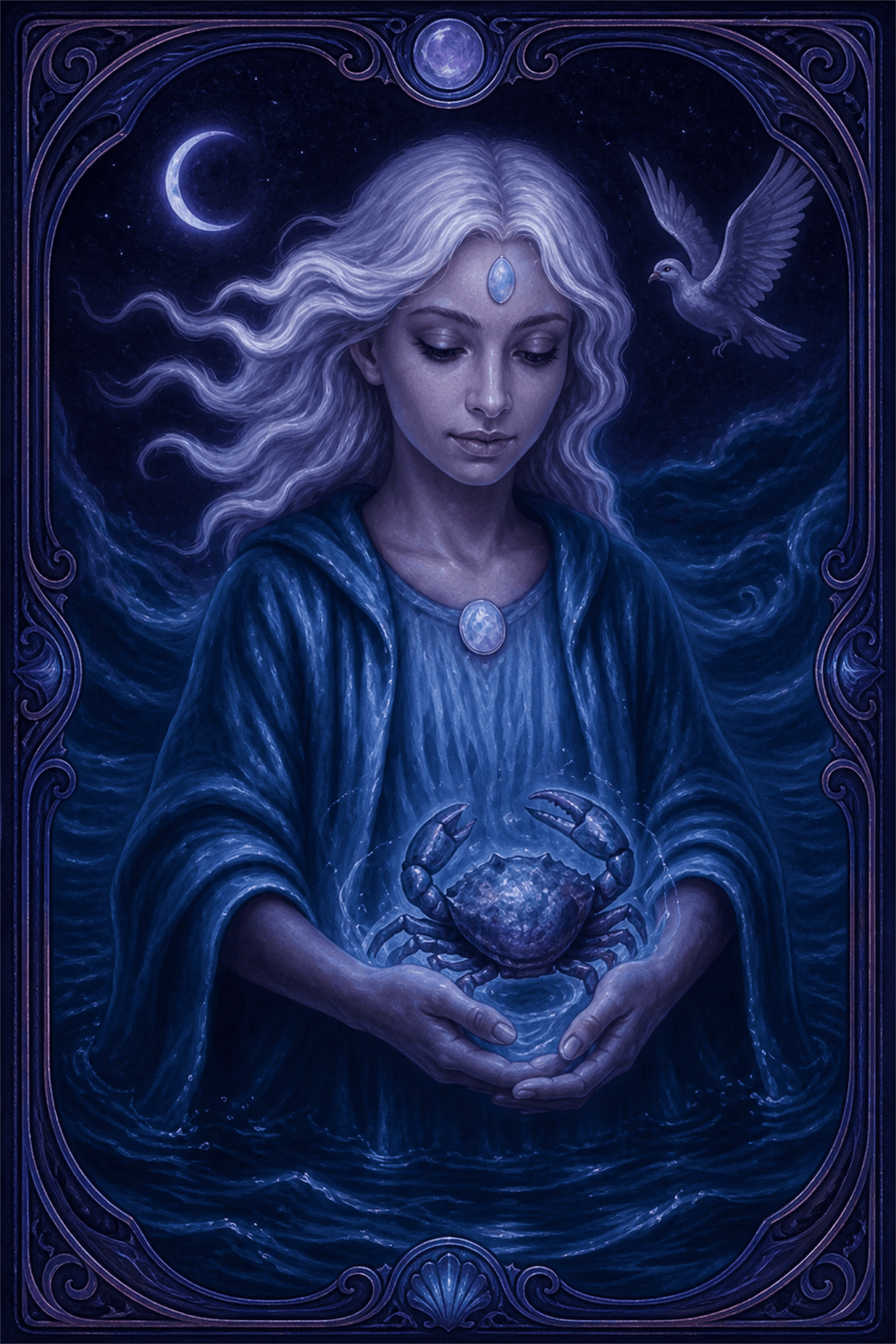
Cancer: Darkness Contains Water
In Cancer, Water becomes sanctuary.
Cancer carries Water through Darkness—the force of boundaries, containment, protection, reflection, and nurture. What Water feels, Darkness surrounds with a protective inner structure.
Cancer’s Water does not flow indiscriminately.
It gathers around belonging.
Emotion becomes home, memory becomes continuity, and care becomes the shelter through which vulnerable life is protected from a world that may not handle it gently.
This is why Cancer’s Water often feels intimate rather than universal.
It moves strongly toward family, chosen family, familiar places, personal history, and the people whose emotional safety has become part of Cancer’s own sense of stability.
Through Cancer, Water becomes the tidepool.
A contained world connected to the larger ocean but protected enough for fragile life to develop within it.
At its best, Cancer creates emotional sanctuary. It makes care dependable, remembers what matters, and gives others a place where vulnerability does not need to become performance.
At its worst, sanctuary becomes enclosure. Care becomes control, memory becomes grievance, and emotional protection prevents people from developing beyond the role Cancer knows how to protect.
Mature Cancer does not preserve connection by preventing change.
It protects the bond strongly enough that growth no longer needs to feel like abandonment.
Cancer is the tidepool that shelters. Cancer carries Water toward sanctuary.
Its question is:
What connection must be protected so vulnerability can survive?

Scorpio: Nether Transforms Water
In Scorpio, Water becomes metamorphosis.
Scorpio carries Water through Nether—the force of instinct, ambition, breakthrough, renewal, rebellion, and transformative pressure. What Water feels deeply, Nether intensifies until the emotional structure can no longer remain unchanged.
Scorpio does not merely experience emotion.
It follows emotion into the hidden systems of power, attachment, fear, desire, betrayal, shame, and identity that produced it.
This is why Scorpio’s Water often feels subterranean.
The visible feeling is rarely the final layer.
Anger may conceal grief. Control may conceal terror of dependence. Obsession may conceal the inability to accept loss. Distance may conceal attachment too intense to risk exposing.
Through Scorpio, Water becomes the undertow.
A force beneath the visible surface capable of pulling experience into depths where its original form cannot remain intact.
At its best, Scorpio transforms emotional pain into insight, resilience, and renewed power. It can remain present inside difficult truths and help expose the emotional structures that keep wounds active.
At its worst, metamorphosis becomes fixation. Pain becomes identity, intimacy becomes possession, and emotional depth is measured through suffering rather than honesty.
Mature Scorpio does not descend merely to prove that darkness exists beneath every bond.
It returns from depth with a form of connection no longer governed by the wound that required the descent.
Scorpio is the undertow that transforms. Scorpio carries Water toward metamorphosis.
Its question is:
What emotional truth must be entered deeply enough that the old pattern can no longer survive?
Symbols of Water
Water is symbolically connected with oceans, rivers, rain, wells, tides, tears, springs, mist, lakes, wombs, cups, mirrors, shells, rainstorms, blood, moonlit seas, waterfalls, wetlands, underground currents, and every image through which separation becomes permeable without disappearing entirely.
Its symbols are not merely soft.
They move.
A river changes shape while retaining direction.
A tide withdraws without abandoning the shore.
Rain enters the soil and becomes part of another living system.
Water’s nature is the Tidal: emotional movement shaped by attraction, rhythm, memory, and return.
Its role is the Weaver: the force that joins separate lives through empathy, care, shared meaning, and emotional exchange.
Its absence becomes the DryHeart: a life protected from emotional pain by becoming unreachable to emotional nourishment.
Common Misunderstandings About Water
Water is not sadness.
Joy, tenderness, desire, grief, compassion, fear, and emotional presence all belong to its range.
Water is not weakness.
Sensitivity increases reception. It does not remove strength.
Water is not passivity.
Patience is active when it remains connected to awareness, boundary, and choice.
Water is not emotional chaos.
Healthy Water regulates movement rather than denying it.
Water is not unconditional access.
Empathy does not require surrendering privacy, safety, or self-respect.
Water is not automatic kindness.
Emotional intelligence can be used to care, manipulate, soothe, or control depending upon the person carrying it.
Water is not Aether.
Water feels connection directly. Aether perceives resonance across larger patterns.
Water is the capacity to receive, carry, and transform emotional experience through living connection.
Nothing more.
Nothing less.
The Legacy of Water
Water is not remembered merely for feeling deeply.
Many people feel deeply while leaving everyone around them responsible for surviving the consequences.
Its true legacy begins when feeling becomes connection—when someone’s pain no longer remained isolated, when a relationship became safe enough for vulnerability, when empathy crossed a division that information alone could not bridge, or when grief was carried long enough to become another form of love.
Water leaves behind the person who felt understood rather than analysed.
The family pattern softened because one person learned to name what everyone else could only repeat.
The work that gave language to an emotion previously lived in silence.
The bond that survived change because both people were allowed to remain distinct.
The care that did not demand permanent dependence in return.
Immature Water wants connection to guarantee that nobody will leave.
Mature Water wants connection to remain honest enough that neither person must disappear in order for the bond to survive.
That is the final evolution of emotional intelligence.
The need to absorb gives way to the ability to attune. Patience gains boundaries. Sensitivity becomes discernment. Empathy stops requiring self-erasure, and flow becomes strong enough to release what can no longer move forward in its former shape.
Water has completed its work when the feeling no longer belongs to one isolated person alone.
It has entered relationship, changed form, and continued moving.
Learn More About Your Elemental Nature
Your Octa Element Chart reveals the elemental force operating at the centre of your identity, how it expresses when balanced, how it distorts under pressure, and what mastery of that pattern may require.