
♋︎ Cancer ♋︎
The Lunar Guardian
"What is loved is worth protecting."
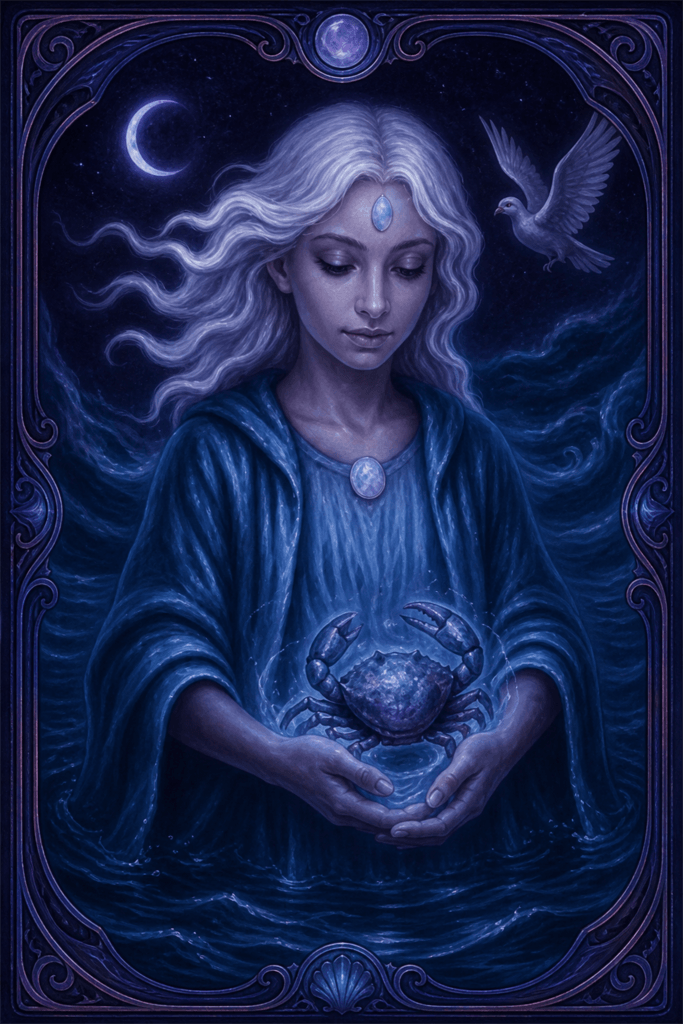
ARCHETYPAL DOSSIER
Quick Cancer Facts
♋︎
Identity
Rulership
Correspondences
Archetypal Signature

Cancer Zodiac Archetype Overview

What is Cancer Zodiac archetype?
Cancer is the keeper of the hearth.
Half tide, half sanctuary, Cancer exists wherever emotion becomes something worth protecting. Water grants empathy, patience, sensitivity, attunement, and the ability to experience life through connection rather than isolation. Darkness gives those emotions gravity. It preserves memory, establishes boundaries, protects what remains vulnerable, and decides what is allowed close enough to matter. Together, Water and Darkness create an archetype built around emotional continuity: the instinct to hold people, places, memories, and relationships together long enough for genuine belonging to form.
Cancer does not simply feel deeply. They remember through feeling. Experiences rarely disappear once they have become emotionally significant because Water carries them forward while Darkness stores their meaning. A house becomes more than walls once memories accumulate inside it. A friendship becomes more than companionship once history binds two people together. Family becomes more than blood once loyalty, sacrifice, conflict, forgiveness, protection, and shared experience have turned separate lives into one emotional landscape. Cancer instinctively understands that humans do not survive through individual strength alone. We survive because somewhere, with someone, we are allowed to belong.
This is why Cancer’s relationship with home reaches far beyond domestic comfort. Home is a psychological state. It is the place where vigilance can soften, where vulnerability does not immediately become weakness, and where identity does not need to be performed for acceptance. Cancer naturally tries to create this state around the people they love. They remember preferences, notice emotional changes, protect private wounds, preserve traditions, and build routines that quietly tell others: you have a place here. Their care often works through details that appear small from the outside but carry enormous emotional weight to the people receiving them.
The Moon deepens this architecture. Within Octa, the Moon governs emotional gravity, attachment security, memory, and the protected inner world. Water creates connection and continuity; Darkness gives that connection boundaries and preservation. Cancer therefore does not move through life only by asking what is happening. Beneath many of their choices sits another question: What must remain emotionally intact when this moment has passed?
This makes Cancer one of the zodiac’s natural continuity-keepers. While others may become fascinated by novelty, achievement, conquest, status, possibility, or transformation, Cancer notices what those pursuits depend upon. Every warrior eventually returns somewhere. Every visionary needs people willing to believe in them. Every child needs a place where failure does not mean exile. Every kingdom eventually depends upon somebody preserving the bonds that make the kingdom worth defending in the first place.
Cancer understands that strength is not always loud.
Sometimes strength is staying beside someone whose pain cannot be fixed. Sometimes it is remembering what everyone else forgot. Sometimes it is protecting the child, the family, the friendship, the tradition, or the vulnerable person while louder personalities compete for recognition. Cancer often becomes strongest when somebody or something they love requires protection. Their sensitivity does not disappear under pressure. It becomes directional. What may look like softness in ordinary circumstances can become extraordinary tenacity once the shell closes around something Cancer has decided belongs within their care.
Their Pure Energy intensifies this instinct. Cancer is Water paired with its direct Prime mirror, Darkness, meaning the two elemental layers reinforce the same underlying force rather than pulling the archetype in separate directions. Emotional depth becomes attached to preservation. Sensitivity becomes attached to protection. Memory becomes attached to identity. Belonging is therefore rarely casual for Cancer. Bonds become part of the internal architecture through which they understand themselves.
At their best, this creates the Lunar Guardian. Cancer becomes emotionally perceptive without becoming invasive, protective without becoming controlling, patient without becoming passive, and nurturing without making other people dependent upon them. They create environments in which others can lower their armour because Cancer understands that vulnerability needs containment before it can become strength. Their empathy allows them to recognize pain. Their Darkness prevents that recognition from remaining merely sentimental by asking what must actually be protected, repaired, remembered, or given time to heal.
Yet the same architecture contains Cancer’s deepest shadow.
Water can absorb too much. Darkness can hold too tightly.
When Cancer becomes frightened of loss, preservation begins turning into possession. Protection becomes smothering. Reflection becomes rumination. Emotional sensitivity becomes martyrdom, while healthy privacy collapses into secrecy or isolation. Cancer may continue carrying relationships, wounds, obligations, and memories long after they have stopped supporting life because release feels dangerously similar to abandonment.
This is where the hearth becomes a cage.
Cancer can begin believing that love must be protected from change itself. They may overfunction for people who need to become responsible for themselves, maintain family roles everyone has outgrown, or hold onto resentment because the wound has become evidence that the relationship once mattered. Their emotional memory is powerful enough that yesterday can remain psychologically present long after circumstances have changed.
The darker Cancer may also struggle to express needs directly. Because they are naturally skilled at noticing subtle emotional shifts in others, they may assume that genuine love should provide the same instinctive understanding in return. Instead of saying, “I need reassurance,” they withdraw and wait to see who notices. Instead of naming anger, they become cold. Instead of setting a boundary, they sacrifice until resentment becomes unbearable. Care then acquires an invisible price, and the people around them may discover that generosity they believed was freely given has quietly become emotional debt.
Cancer’s evolution therefore depends upon learning that protection and control are not the same thing.
A healthy home does not prevent anyone from leaving. It gives them somewhere safe enough to return.
Mature Cancer learns that love does not become weaker when another person develops independence. Memory does not become meaningless when life changes. Care does not require self-erasure, and boundaries do not require isolation. They learn to protect what matters without freezing it into the shape it once had.
This is the deeper purpose of the Lunar Guardian. Cancer is not here merely to preserve the past. They are here to preserve the emotional continuity through which people can survive change without losing their sense of belonging.
At their highest expression, Cancer becomes the person who makes strength possible in others because they have created somewhere that strength does not need to perform constantly. Their gift is the safe harbor, the remembered promise, the protected wound, the familiar light still burning when someone finally returns exhausted from the world.
At their lowest expression, that same harbor closes its gates and demands that nobody leave.
Cancer’s path is learning the difference.
In short: Cancer is either the Lunar Guardian who turns empathy into belonging or the wounded protector who holds so tightly that love can no longer breathe. Half tide, half sanctuary, they carry memory, care, protection, and emotional continuity. Balanced, they create places where people feel safe enough to grow. Unbalanced, they preserve what should already have been allowed to change.
Cancer Strengths
What are Cancer’s Blessings?
- Emotional Attunement
Cancer notices what is happening beneath the visible interaction. Changes in tone, distance, routine, expression, and emotional availability often register before anyone has explained what is wrong. Balanced Cancer uses this sensitivity to respond accurately rather than assume responsibility for every shift they perceive. - Protective Loyalty
Once Cancer accepts someone into their inner circle, loyalty becomes more than affection. They remember the history of the bond and instinctively protect what has been entrusted to them. Their devotion often becomes strongest during illness, grief, failure, family crisis, or moments when another person feels least worthy of support. - Relational Memory
Cancer rarely experiences people only through the present moment. They remember preferences, promises, wounds, victories, traditions, and subtle details others forget. This gives their relationships continuity and makes people feel known across time rather than merely noticed in the moment. - Nurturing Presence
Cancer has a natural ability to create emotional shelter. Through listening, food, humour, reassurance, physical comfort, practical care, or simply remaining nearby, they can make difficult experiences feel survivable without pretending those experiences are easy. - Patient Compassion
Water gives Cancer the ability to remain present with processes that cannot be rushed. They understand that trust, grief, healing, intimacy, and personal growth often unfold slowly. Where others become impatient with vulnerability, Cancer can provide the time required for something fragile to strengthen. - Protective Discernment
Darkness gives Cancer a strong instinct for privacy and emotional boundaries. Mature Cancer understands that not every person deserves equal access, not every truth belongs in every room, and not every vulnerable part of someone should be exposed simply because disclosure is possible. - Continuity Under Pressure
Cancer can keep emotional meaning alive while circumstances become unstable. Families, relationships, teams, and communities often survive difficult periods because Cancer remembers why the bond matters when everyone else is reacting only to the immediate crisis.
Cancer Weaknesses
What are Cancer’s Curses?
- Emotional Overidentification
Cancer may become so identified with a relationship, family role, or responsibility that separation feels like losing part of themselves. The bond stops being something they participate in and becomes something they require in order to recognize who they are. - Martyrdom Through Care
Their sensitivity can become self-sacrifice when Cancer gives more than they genuinely consent to give. Rather than establish limits, they continue helping until exhaustion becomes resentment and suffering becomes evidence that others should have appreciated them more. - Protective Smothering
Care becomes distorted when Cancer protects people from experiences they actually need in order to grow. Advice becomes interference, concern becomes supervision, and emotional support slowly becomes a structure designed to keep the other person dependent. - Silent Resentment
Cancer may avoid confrontation until the emotional archive is already full. Rather than state the problem early, they remember every disappointment, missed gesture, forgotten promise, and moment of perceived neglect until one current conflict carries the accumulated weight of many previous ones. - Withdrawal as Punishment
When hurt, Cancer can retreat behind silence, distance, reduced affection, or emotional inaccessibility while expecting the other person to understand why. Privacy becomes control when withdrawal is used to create anxiety rather than provide genuine space for reflection. - Rumination and Emotional Stagnation
Darkness remembers and Water carries experience forward. When both invert, Cancer can revisit the same wound endlessly without allowing new evidence, grief, forgiveness, or changed circumstances to alter its meaning. - Manipulative Vulnerability
Cancer’s emotions can become coercive when pain, sacrifice, helplessness, family obligation, or guilt is used to restrict another person’s choices. The behaviour may feel like protection from Cancer’s perspective while functioning as emotional control from the outside.
Cancer Growth Pillars
How do Cancer evolve?
- Communicate Before Resentment Forms
Say what hurts while the problem is still small enough to repair. Emotional sensitivity gives Cancer valuable information, but that information becomes destructive when everyone else is expected to decode it without being told what happened. - Protect Without Possessing
Love someone enough to defend their growth, including the parts of that growth that move beyond Cancer’s immediate control. Protection becomes mature when the person being protected becomes more capable rather than more dependent. - Separate Intuition From Memory
A familiar feeling does not automatically mean the same event is happening again. Ask what belongs to the present situation and what has been activated from an older wound before treating emotional recognition as proof. - Receive Care Without Testing It
Allow people to support you imperfectly. Do not hide the need, reject the first attempt, and then interpret the failure to read your mind as evidence that nobody truly cares. - Let Grief Complete Its Movement
Some relationships, identities, homes, and chapters genuinely end. Honouring what mattered does not require preserving its active form forever. Release allows memory to remain meaningful without becoming a prison. - Build Identity Beyond Caretaking
Develop work, friendships, interests, values, skills, and private ambitions that belong to Cancer independently of who currently needs them. Being useful can strengthen connection, but usefulness should never become the price of belonging. - Turn Boundaries Into Language
Do not wait until the shell becomes a wall. State limits directly while affection is still intact. A clear boundary protects relationships more effectively than resentment disguised as patience.
Cancer Pitfalls
How do cancer regress?
- Confusing Being Needed With Being Loved
Dependency can keep people nearby while quietly destroying genuine intimacy. Cancer may become indispensable because indispensability feels safer than trusting that someone would remain voluntarily. - Treating Memory as Evidence of Permanence
A relationship can have been profound and still be finished. History proves that something mattered; it does not automatically prove that its old form should continue. - Making the Emotional Climate Everyone’s Responsibility
Cancer’s mood deserves attention, but it cannot become an atmosphere everyone else must constantly manage. Feeling wounded does not automatically make others responsible for restoring emotional equilibrium. - Protecting People From Necessary Consequences
Helping becomes sabotage when Cancer repeatedly prevents someone from learning through their own choices. Rescue may preserve immediate peace while quietly weakening long-term competence. - Building Loyalty Tests Nobody Knows Exist
Cancer may withdraw, become unusually quiet, create distance, or stop offering care to see who notices. Hidden tests produce evidence of misunderstanding more often than evidence of love. - Turning Family Into Moral Authority
History, blood, sacrifice, marriage, parenthood, and tradition can carry enormous meaning without granting unlimited access. “Family” cannot become a permanent exemption from accountability. - Preserving the Sanctuary After Life Has Left It
The instinct to protect becomes corruption when Cancer maintains relationships, roles, routines, or family structures whose living purpose disappeared long ago. A home preserved without life eventually becomes a museum.
What do people think about Cancer?
Cancer and First Impressions
Cancer often appears gentler and more accessible than they truly are. They meet unfamiliar environments through emotional observation, instinctively noticing who appears comfortable, who feels excluded, where tension is being concealed, and whether the atmosphere is safe enough for genuine participation. Before revealing themselves, Cancer studies the emotional weather.
Water gives their presence receptivity. Cancer listens not only to what people say, but to changes in tone, hesitation, silence, posture, and relational distance. They often sense when somebody is upset before the person has admitted it, and they may adjust their own behaviour to soften the room without drawing attention to what they noticed.
Darkness adds privacy and selective gravity. Cancer may appear warm while still withholding the deeper self. They can offer humour, food, sympathy, familiarity, practical concern, or personal questions without granting equal access to their own vulnerability. Others may feel welcomed into Cancer’s atmosphere while remaining outside the protected chamber where their fears, attachments, resentments, and emotional history are stored.
Balanced Cancer appears compassionate, attentive, loyal, and emotionally intelligent. Their presence communicates that weakness will not automatically be mocked and that complicated feelings do not need to be cleaned up before they can be shared. They create social shelter. People often disclose private information around Cancer because the interaction feels less like performance and more like being temporarily allowed to return home.
Cancer also possesses a quiet capacity for social memory. They remember names, preferences, anniversaries, wounds, family details, old conversations, and changes in another person’s emotional state. This can make their care feel unusually personal because Cancer rarely responds only to the present moment. They respond to the continuity of who someone has been.
Unbalanced Cancer becomes excessively watchful. Sensitivity turns into suspicion, and ordinary changes in tone or availability are interpreted as rejection. Instead of asking what happened, they begin collecting emotional evidence. A delayed reply, forgotten detail, distracted expression, or altered routine may be absorbed into an internal story about abandonment, disrespect, or fading loyalty.
Their Mask can then become the endlessly caring one: the parent of the group, the emotional medic, the dependable host, the person who claims to need very little while quietly remembering every occasion on which care was not returned. Others receive nourishment without realizing that Cancer may be keeping an unspoken account of who noticed their needs and who did not.
When hurt, Cancer may remain polite while withdrawing emotional access. Their warmth cools, answers shorten, invitations disappear, and the other person is expected to recognize the injury without being told directly. This creates one of Cancer’s most common social contradictions: they are highly skilled at detecting unspoken needs in others and may therefore assume others should detect theirs with equal accuracy.
The social mastery of Cancer begins when sensitivity becomes communication rather than surveillance. They do not need to expose everything or trust immediately. They need to distinguish intuition from fear and privacy from indirect punishment.
Mature Cancer remains receptive without becoming porous. They make others feel safe while allowing themselves to be known clearly enough that care can become reciprocal.
Cancer as a Mythic Archetype
Reveal
Penelope — The Hearth-Weaver
Cancer resonates with Penelope, the legendary queen of Ithaca who preserved her household, lineage, and inner loyalty through twenty years of uncertainty.
She is the hearth-weaver.
The keeper of return.
The one who watches strangers occupy her home and quietly decides:
“You may enter these walls, but you will not decide what they mean.”
Penelope does not defend Ithaca through physical conquest. She protects it through memory, patience, emotional intelligence, strategic concealment, and an almost impossible capacity to remain connected to what absence has not yet erased. Her strength operates inwardly. While warriors fight across oceans, Penelope fights to prevent home itself from being rewritten.
This is Cancer’s Water. Water carries emotional continuity across time. It remembers the bond when physical evidence has disappeared and holds connection through uncertainty, grief, longing, and change. Penelope does not experience Odysseus merely as a man who is absent. He remains part of the emotional architecture through which her marriage, identity, family, and kingdom are understood.
Darkness appears through containment and protection. Penelope guards what cannot safely be exposed. Surrounded by suitors attempting to claim her home and authority, she survives through discretion rather than open declaration. She promises to choose a husband after completing a burial shroud, weaving during the day and secretly unweaving it at night. Darkness conceals her true intention until it can survive revelation.
The loom becomes a Cancerian symbol. Every thread represents memory, promise, lineage, grief, and belonging. Penelope does not simply create fabric. She controls whether the story is allowed to reach its forced conclusion. By undoing the work each night, she protects the unfinished state in which return remains possible.
Her strategy reveals the power of Pure Water and Darkness. Penelope’s loyalty is not merely something she practises. It becomes the pillar around which her identity is organized. The household must remain intact because allowing it to be claimed would mean surrendering the continuity through which she still recognizes herself.
Balanced Cancer carries the same capacity. They can preserve hope during prolonged uncertainty, protect vulnerable people without public recognition, and keep the emotional centre of a family or community alive while external structures collapse. Their courage is rarely theatrical. It appears through remaining, remembering, feeding, waiting, tending, and refusing to let temporary chaos define what something permanently means.
Yet Penelope also reveals Cancer’s shadow.
Life can become suspended around what has not returned. Loyalty can prevent movement. Memory can become more authoritative than present reality. The protected home can remain so devoted to the past that the future is never permitted to enter honestly.
Cancer may weave and unweave the same emotional story for years. During the day, they appear to move forward. At night, memory quietly restores everything to its previous state. A relationship ends, but the emotional household remains arranged for its return. A betrayal occurs, but the wound is preserved because releasing it would also release the meaning attached to it.
Penelope’s mastery lies in discernment. When Odysseus finally returns disguised, she does not surrender immediately to longing. She tests him. She asks for knowledge only the true husband could possess: the secret of the marriage bed built into the living tree. Emotion does not override caution. Water remembers the bond; Darkness verifies who should be allowed inside it.
This is Cancer at its highest expression. They do not protect everyone indiscriminately. They recognize the difference between familiarity and belonging, need and loyalty, performance and proven intimacy.
Cancer carries the same trial as Penelope: to preserve love without becoming imprisoned by waiting, to protect home without turning it into a tomb, and to remember faithfully without demanding that life remain identical to memory.
The Lunar Guardian does not merely wait for someone to return.
They preserve what is sacred while ensuring that the sacred remains alive.
Cancer and Elements
What Are Cancer’s Elements?
Cancer Energy Type: Pure — Water + Darkness
Cancer carries Pure Energy because Water is paired with its exact Prime mirror, Darkness. Water connects experience through feeling, attachment, empathy, and memory. Darkness gives that emotional current containment, boundaries, gravity, and protection. Both elements move inward, strengthening the inner world rather than dispersing energy away from it.
This creates one of the most emotionally concentrated configurations in the Octa Zodiac.
Pure Energy means Cancer uses the balanced and inverted definitions of Water and Darkness as foundational pillars of identity. Emotional continuity, belonging, nurture, protection, memory, privacy, loyalty, and attachment are not merely behaviours Cancer occasionally performs. They become part of how Cancer understands who they are.
The underlying declaration of Pure Cancer is:
“These bonds define me.”
Cancer does not simply remember the people they love. Those people become part of the inner architecture through which the self is experienced. Home may be a place, but it can also be a person, family, tradition, language, familiar smell, inherited object, repeated ritual, remembered season, or emotional atmosphere. Cancer gathers these fragments into a protected internal world and carries that world forward.
Water says: “Remain connected.”
Darkness answers: “Protect what the connection contains.”
Because the elements reinforce the same force, Cancer possesses substantial emotional coherence. Their moods may change rapidly, but the deeper attachments beneath those moods often remain stable. They may retreat, become defensive, or appear contradictory while still organizing every reaction around the same central questions: Am I safe here? Does this bond remain real? Do I still belong? Can what I love survive exposure?
Pure Cancer therefore differs from ordinary emotionality. Their feelings possess continuity. A present event can awaken an entire history because Water experiences moments relationally while Darkness stores their meaning. What appears like an exaggerated reaction may contain several older injuries that the current situation has activated simultaneously.
At its highest expression, this creates extraordinary loyalty, empathy, emotional intelligence, and protective devotion. Cancer can remain connected during grief, illness, change, failure, and vulnerability because the relationship is not valued only for its pleasant moments. They understand that continuity is built by surviving tides rather than pretending tides do not exist.
At its lowest expression, emotional coherence becomes enclosure. Cancer’s internal story becomes self-sealing. Memories, intuitions, fears, and interpretations reinforce one another until outside information can no longer enter without being treated as a threat.
The same purity that creates loyalty can create emotional rigidity. Cancer may become convinced that because a feeling is deep, it must also be accurate; because a bond was meaningful, it must remain active; or because they remember an injury clearly, the other person’s present growth cannot be trusted.
The central task of Pure Cancer is not to become less emotional or less protective.
It is to keep the sanctuary alive enough that new truth can still enter it.
The Strength of Pure Energy
The strength of Pure Energy is continuity under pressure. Cancer can hold emotional meaning steady while external circumstances become unstable. They remember who people are beneath temporary failure, recognize the history surrounding an isolated mistake, and protect relationships from being discarded during moments of fear, anger, illness, or confusion.
This makes Cancer exceptionally powerful wherever survival depends upon emotional cohesion. Families, communities, partnerships, and teams do not endure through structure alone. They endure because somebody remembers why the structure matters. Cancer often becomes that person.
Their loyalty is not merely obedience or habit. It is relational memory. Cancer remembers who stood beside them, who showed care without being asked, who remained during difficulty, and who treated vulnerability with dignity. Once trust has entered their protected world, they can invest with remarkable patience.
Pure Energy also gives Cancer a stable internal reference point. They may adapt their behaviour to different people, yet their deeper values often remain rooted in protection, care, belonging, emotional sincerity, and continuity. This makes them difficult to convince that human needs should be sacrificed simply because efficiency, ambition, popularity, or abstraction demands it.
Cancer notices the invisible cost of decisions. They see the child affected by the family conflict, the exhausted worker hidden beneath productivity numbers, the elderly relative excluded from convenience, the grieving person everyone expects to recover quickly, and the emotional consequences that remain after the public event has ended.
Their empathy therefore carries a preserving function. Cancer does not merely feel alongside others. They help keep human meaning from being erased by systems that move too quickly to remember it.
Pure Energy grants Cancer unusual resilience through attachment. They often become stronger when protecting someone or something they love. A Cancer who struggles to defend themselves may become fearless when their child, partner, family, home, community, or vulnerable person is threatened. Connection gives their sensitivity a boundary and their fear a purpose.
At maturity, Pure Cancer becomes an emotional anchor. Their presence tells others that pain does not cancel belonging, imperfection does not automatically end love, and vulnerability can be held without becoming spectacle.
The strongest Cancer does not make others dependent upon their shelter.
They help others develop an inner home capable of surviving when Cancer is no longer present.
The Challenge of Pure Energy
The challenge of Pure Energy is that identity can become inseparable from attachment. When Water and Darkness consolidate around belonging, Cancer may struggle to understand who they are outside the roles, memories, duties, and relationships through which they have learned to feel necessary.
They may become the caretaker, parent, emotional translator, family historian, protector, injured child, loyal partner, or person who never abandons anyone. These identities can be noble, but they become dangerous when Cancer cannot release them without feeling that the self is disappearing.
Pure Cancer may therefore preserve roles long after the relationship has outgrown them. They continue parenting an adult who needs autonomy, rescuing a friend who refuses responsibility, protecting a partner from consequences, or carrying family pain that was never theirs to resolve.
Their internal coherence can also become emotional certainty. Cancer feels the pattern, remembers similar wounds, and senses danger. Because these processes occur quickly and deeply, intuition may appear unquestionable. Yet memory can misidentify the present. A current disagreement is interpreted through an earlier betrayal, and Cancer responds to both at once.
This creates emotional enclosure. The inner story becomes protected from contradiction because contradiction itself feels unsafe. Reassurance is rejected as insincere, explanation is treated as evasion, and requests for space become proof that abandonment has already begun.
Pure Energy also makes release difficult. Cancer does not experience the end of a bond as the simple absence of another person. They feel the collapse of routines, memories, imagined futures, shared language, family structure, and the version of self that existed inside the relationship.
They may therefore cling to emotional remains. Old messages, objects, rituals, grievances, and fantasies of reconciliation preserve continuity after living connection has ended. The sanctuary becomes a mausoleum.
Another danger is moralizing care. Because Cancer identifies strongly with protection, they may assume that what feels protective must also be right. Control is renamed concern. Interference is renamed responsibility. Guilt is used to prevent separation. Emotional dependence is interpreted as proof of love.
The challenge is not that Cancer cares too deeply.
It is that care can become a justification for refusing another person’s independence.
Mature Cancer learns that a bond can change without becoming meaningless, that separation does not erase love, and that emotional truth must remain open to present evidence.
The sanctuary must protect life.
It cannot demand that life stop growing in order to remain protected.
Elemental Influence on Cancer
Water Empowerment
Water empowers Cancer with depth, patience, attunement, empathy, sensitivity, and flow. It is the Core Element through which their internal world enters visible life.
Depth allows Cancer to experience people and events beyond their immediate surface. They notice the history beneath behaviour, the wound beneath anger, the fear beneath arrogance, and the need beneath apparent indifference. They rarely experience relationships as isolated interactions. Every exchange enters a larger emotional continuity.
Patience gives Cancer the capacity to remain present while others unfold gradually. They understand that trust cannot always be forced and that grief, healing, intimacy, and belonging develop through repeated safety rather than one dramatic conversation.
Attunement allows them to sense emotional changes quickly. Cancer may recognize tension before words are exchanged, understand when reassurance would help, or notice when another person requires silence rather than advice. At its highest expression, this creates relational precision.
Empathy gives Cancer access to perspectives that cannot be reached through argument alone. They can understand why somebody reacted as they did without automatically approving the reaction. This distinction allows mature Cancer to combine compassion with accountability.
Sensitivity makes experience vivid. Beauty, rejection, tenderness, cruelty, atmosphere, music, smell, tone, and memory enter Cancer deeply. Their nervous system often receives more relational information than they consciously realize.
Flow allows Cancer to respond without forcing every situation into the same shape. They can comfort, wait, retreat, adapt, nourish, or move around resistance when direct confrontation would damage what they are trying to preserve.
At its highest expression, Water becomes emotional intelligence. Cancer does not drown in feeling or deny it. They understand what the feeling contains, where it came from, what belongs to the present, and what action would allow the emotional current to move without destroying its banks.
Darkness Empowerment
Darkness empowers Cancer with containment, protection, caution, wisdom, reflection, and nurture. It is the Prime Element that determines what their Water holds, what receives access, and what must be protected from premature exposure.
Containment gives Cancer the ability to hold difficult emotion without immediately releasing it into the environment. They can sit beside grief, fear, confusion, and vulnerability without demanding a quick solution. Some experiences require a protected chamber before they can be understood.
Protection directs Cancer’s sensitivity toward safeguarding life. They instinctively notice who lacks support, what bond is becoming fragile, where trust has been violated, and which emotional boundary must be reinforced.
Caution prevents empathy from becoming indiscriminate access. Balanced Cancer understands that tenderness should not be offered without awareness and that vulnerability must be entrusted to people capable of respecting it.
Wisdom develops through emotional memory. Cancer often recognizes recurring patterns because they remember not only what happened but how it felt, what preceded it, and what followed after everyone else stopped paying attention.
Reflection allows experience to become meaning. Cancer revisits the past not merely to repeat it, but to understand the continuity between earlier events and present behaviour. Healthy reflection turns memory into guidance.
Nurture is Darkness’s capacity to protect growth while it remains fragile. Cancer creates environments in which people can recover, develop, confess, rest, and become strong enough to face the external world again.
At its highest expression, Darkness becomes gravitational wisdom. Cancer knows what should be held close, what should be released, what must remain private, and when protection has completed its purpose.
The mature Cancer does not hide life from reality.
They give life enough shelter to meet reality without being destroyed by it.
Water Inversion
When Water inverts, depth becomes shallowness, patience becomes passivity, attunement becomes disconnection, empathy becomes apathy, sensitivity becomes martyrdom, and flow becomes stagnation.
Shallowness may sound incompatible with Cancer, yet inverted depth does not always mean a lack of feeling. It can mean emotion without genuine self-examination. Cancer experiences the intensity of hurt while refusing to investigate how expectation, fear, projection, or indirect communication contributed to it.
Patience becomes passivity when Cancer waits for situations to repair themselves. They tolerate neglect, resentment, dependency, or disrespect because taking decisive action threatens the bond they are attempting to preserve.
Attunement becomes disconnection when Cancer withdraws so completely that they stop receiving present information. They become attuned only to the internal story, interpreting everything through what they already fear.
Empathy becomes apathy after prolonged emotional overextension. Cancer may care for everyone until numbness becomes the only remaining boundary. They then appear cold, unavailable, or indifferent because sensitivity has exhausted itself.
Sensitivity becomes martyrdom when suffering becomes evidence of love. Cancer gives beyond consent, refuses to state limits, and later treats exhaustion as proof that others failed to appreciate them.
Flow becomes stagnation when feeling circles without movement. The same injury is revisited repeatedly, but no decision, conversation, boundary, grief process, or release is allowed to change its course.
The shadow of inverted Water is emotion that cannot complete its movement. Everything is felt, but nothing is allowed to pass.
Darkness Inversion
When Darkness inverts, containment becomes secrecy, protection becomes isolation, caution becomes prejudice, wisdom becomes ignorance, reflection becomes rumination, and nurture becomes smothering.
Containment becomes secrecy when Cancer withholds needs, plans, resentment, and vulnerability to preserve control. They expect others to infer what has been hidden and interpret failure as proof that the bond lacks genuine care.
Protection becomes isolation when Cancer retreats behind home, routine, family roles, emotional withdrawal, or selective silence until nobody can reach the person beneath the shell.
Caution becomes prejudice when unfamiliarity is treated as danger. Cancer may distrust outsiders, new partners, changing traditions, different lifestyles, or anyone who threatens the established emotional hierarchy.
Wisdom becomes ignorance when memory is allowed to overrule present evidence. Cancer assumes that because someone behaved one way before, they are incapable of growth, or that because one relationship ended painfully, similar intimacy must produce the same result.
Reflection becomes rumination when the mind repeatedly returns to the wound without moving toward understanding. Details are reviewed, conversations reconstructed, motives interpreted, and emotional evidence collected until memory becomes a closed courtroom.
Nurture becomes smothering when care requires dependence. Cancer may solve problems others need to face, prevent necessary risk, interfere with choices, or make separation feel like betrayal.
The shadow of inverted Darkness is a sanctuary whose door can no longer open.
Nobody is harmed by the outside world because nobody is permitted to leave.
The Combined Elemental Shadow of Cancer
WHAT IS The Dark side of Cancer?
Water absorbs while Darkness contains. When both elements invert, Cancer develops the enclosed-tide instinct: a psychological state in which emotion enters deeply but cannot move outward through direct communication, release, or adaptive change.
The visible shadow appears as withdrawal, guilt, mood-based control, emotional surveillance, possessiveness, silent resentment, martyrdom, nostalgia, indirect punishment, and smothering care. Beneath these behaviours lies a central fear: Cancer often believes that what is not emotionally bound can disappear.
They therefore attempt to make relationships heavy enough to remain.
Love becomes obligation. Memory becomes a contract. Sacrifice becomes leverage. Care becomes proof of ownership. Family becomes a moral claim against independence. The past is repeatedly invoked to prevent the present from changing direction.
Cancer’s manipulation is rarely experienced internally as manipulation. They may sincerely believe they are expressing pain, protecting the family, preserving loyalty, or reminding somebody what the relationship once meant. Yet emotion becomes coercive when another person is denied the right to choose freely without being punished through guilt, withdrawal, illness, helplessness, or emotional catastrophe.
The shell also creates projection. Cancer may become intensely reactive toward people they experience as selfish, detached, forgetful, disloyal, emotionally cold, ungrateful, or unwilling to commit. Some of these behaviours genuinely violate their values. Others represent qualities Cancer has exiled from their own identity: independence, emotional distance, self-prioritization, change, confrontation, and the right to leave what no longer fits.
They may be attracted to people who carry these missing forces, then resent them for refusing to become permanent residents inside Cancer’s emotional world.
The deepest shadow is not moodiness.
It is the belief that love can be made safe by removing the other person’s freedom to withdraw it.
Integration does not require Cancer to become colder, less loyal, or less nurturing. It requires them to allow emotional bonds to remain voluntary. When Cancer claims directness, independence, adaptability, anger, and the capacity to survive separation, protection becomes support rather than possession.
The shell becomes a boundary.
It stops becoming a prison.
Moon’s Influence on Cancer
How the Moon governs Cancer?
The Moon governs emotional gravity.
Within the Octa framework, the Moon is the Pure Anchor of Darkness through Cancer’s Water + Darkness configuration. Cancer does not carry Darkness through an opposing Core channel. Water and Darkness mirror one another directly, concentrating attachment, memory, protection, emotional continuity, and belonging into one coherent inner structure.
The Moon does not simply make Cancer emotional. Emotion alone does not explain the archetype. The Moon governs the mechanism through which experience becomes emotionally significant, absorbed into memory, attached to identity, and carried forward through relationships.
Cancer receives experience through Water and holds it through Darkness. Who belongs here? What must be protected? What does this moment mean for the relationship? What has happened before? What should be remembered? What must remain safe enough for connection to continue?
This creates Cancer’s talent for emotional attunement, caregiving, loyalty, memory, family-building, hospitality, preservation of tradition, and the creation of psychologically protected spaces. They often notice what strengthens or destabilizes belonging long before the problem becomes visible through explicit conflict.
The Moon also explains their continuity instinct. Cancer rarely experiences important relationships as isolated moments. Present behaviour enters an emotional history. Repeated care deepens security, while repeated injury accumulates meaning. Their Pure Energy gives this memory unusual coherence. Balanced Moon allows the past to inform the present without controlling it.
Inverted Moon turns protection into smothering. Attachment becomes dependency, memory becomes grievance, privacy becomes isolation, and care becomes an attempt to control another person’s independence. Cancer may protect the emotional world so aggressively that nothing new is allowed to enter it without first proving it poses no threat.
The Moon’s highest expression in Cancer is secure belonging: the capacity to remember without becoming imprisoned by memory, protect without controlling, and create bonds strong enough to offer safety without demanding that everyone inside them stop growing.

Cancer Trials and Challenges

Cancer’s Curse — Core Wound: The Unheld One
Cancer may carry a deep sensitivity to the possibility that emotional care can disappear precisely when it is needed most.
The exact history varies. Some experience inconsistent affection, emotionally unavailable caregivers, family instability, premature responsibility, unpredictable moods, abandonment, divorce, illness, relocation, or environments in which they were required to understand everyone else while nobody attempted to understand them.
Others grow up inside physically stable homes where emotional truth is nevertheless unsafe. Needs are minimized, sensitivity is mocked, conflict remains unspoken, or love is available only when Cancer behaves according to the family’s expectations.
The internal conclusion becomes:
“If I am not necessary, I may not be kept.”
Cancer therefore learns to become useful to attachment. They remember everything, anticipate needs, manage emotional climates, preserve family connections, comfort others, and make themselves difficult to replace. Care becomes both gift and survival strategy.
Their deepest fear is not simply loneliness. It is being emotionally unheld: experiencing pain that nobody recognizes, needing comfort that never arrives, or discovering that the bond mattered more to Cancer than it did to the other person.
This wound can make receiving care strangely difficult. Cancer may long to be protected but distrust anyone attempting to protect them. They test loyalty indirectly, conceal needs, reject help, and later feel confirmed when others fail to provide exactly what was never clearly requested.
The wound becomes self-reinforcing. Cancer overfunctions, others become accustomed to receiving, resentment grows, and Cancer withdraws. The other person becomes confused or defensive, which confirms Cancer’s belief that nobody sees what they carry.
They then protect themselves by becoming even more indispensable.
The Unheld One becomes the holder of everyone else.
Healing the Wound
Cancer heals when they discover that belonging does not need to be purchased through emotional labour.
The first stage is naming needs before resentment has converted them into accusation. “I need reassurance,” “I cannot carry this today,” “I felt excluded,” or “I need you to take responsibility” gives the other person a real opportunity to respond. Hidden tests create evidence, not intimacy.
Healing also requires differentiation. Cancer must learn that connection between two people does not erase the boundary between them. Another person’s sadness is not automatically Cancer’s responsibility. Their anger does not prove Cancer has failed. Their independence does not necessarily mean the bond is disappearing.
Cancer benefits from receiving imperfect care. Someone may love them deeply without anticipating every need, remembering every detail, or expressing affection in the same language. Accepting care in the form actually offered prevents emotional precision from becoming an impossible entrance requirement.
Grief is another essential part of healing. Cancer often preserves emotional remains because release feels like abandonment of what once mattered. Conscious grief allows the bond to change form without being denied or erased.
They also heal by creating internal continuity. Personal routines, private values, creative practices, financial competence, physical self-care, friendships, and meaningful work ensure that identity does not collapse whenever one relationship changes.
The goal is not radical independence. Cancer is relational by nature. Their strength develops through attachment.
The goal is secure interdependence: the ability to love deeply while knowing that the self will remain present even if the tide changes.
Cancer does not betray the heart by developing a spine around it.
The spine is what allows the heart to remain open without being carried away.
Life Lessons for Cancer
Cancer must learn that being needed and being loved are not the same condition. Dependency may guarantee proximity, but it cannot guarantee genuine affection.
They must understand that protection is successful when the protected person becomes stronger. Care that prevents independence may feel devoted while quietly weakening the person it claims to preserve.
Cancer must learn to communicate before the emotional atmosphere becomes a weapon. Silence can protect reflection, but silence used to create anxiety is indirect control.
They must distinguish memory from prophecy. The past provides information, not certainty. A present person should not be sentenced for an earlier person’s betrayal merely because the emotional pattern feels familiar.
Cancer also needs to recognize anger as a boundary signal. When anger is denied because it appears incompatible with nurture, it returns through resentment, sarcasm, guilt, withdrawal, or self-sacrifice. Direct anger is often kinder than prolonged emotional punishment.
They must allow family to remain human. Blood, history, parenthood, marriage, and shared suffering do not automatically justify endless access. A relationship can be significant and still require distance.
Another lesson concerns mood. Feelings deserve attention, but they do not possess automatic authority over everyone in the environment. Cancer must learn to experience emotion without requiring the entire room to orbit it.
Most importantly, Cancer must accept that home is not a frozen arrangement.
A living home changes as the people inside it grow.
The Lunar Guardian does not preserve every previous form of belonging. They protect the deeper bond strongly enough that it can survive becoming something new.
Cancer and Stability
Cancer creates stability through emotional rhythm. Familiar spaces, trusted relationships, repeated rituals, meaningful objects, predictable communication, shared meals, photographs, music, family traditions, and private recovery time help their nervous system recognize that life remains connected.
Physical environment matters because Cancer absorbs atmosphere. A chaotic, hostile, exposed, or emotionally unpredictable home can drain them even when external circumstances appear manageable. They require some protected territory in which vigilance can decrease.
Balanced Cancer builds stability through responsive continuity. Their routines contain enough familiarity to provide security but enough flexibility to accommodate changing emotional needs. They maintain relationships without demanding constant proximity and preserve traditions without treating adaptation as betrayal.
Instability appears when safety becomes dependent upon everyone remaining emotionally available in the expected way. A partner’s changing schedule, child’s increasing independence, friend’s new relationship, family member’s relocation, or alteration in household rhythm may feel larger than the event itself because it threatens the architecture of belonging.
Cancer may then attempt to restore stability by increasing contact, asking repeated questions, becoming overly helpful, withdrawing, or making others feel guilty for changing.
Healthy Cancer stability requires several centres of gravity. Home matters, but identity cannot depend entirely upon home. Family matters, but family cannot carry every emotional need. Memory matters, but the present must remain capable of revising it.
Cancer benefits from explicit agreements. Clear responsibilities, communicated boundaries, planned solitude, financial routines, shared calendars, and direct conversations reduce the amount of uncertainty their intuition is forced to fill.
The mature Cancer does not build a home nobody can leave.
They build a home people can return to without surrendering the lives they developed outside it.
Cancer Under Pressure
Cancer usually detects pressure before others recognize that anything has changed. Their breakdown begins through heightened attunement.
First, Water absorbs the atmosphere. Cancer notices altered tone, emotional distance, disorder, fatigue, financial anxiety, conflict, or signs that somebody they love is struggling. They begin carrying information that has not yet been discussed openly.
Next, Darkness tightens containment. Cancer shares less, watches more, and attempts to protect the vulnerable system from further disruption. They may take on additional responsibilities, control access, conceal fear, or retreat toward familiar people and routines.
Then memory activates. The present situation becomes connected to older experiences of abandonment, betrayal, humiliation, instability, or helplessness. Cancer is no longer responding only to what is occurring now. The entire emotional archive enters the room.
The next stage is rumination. They review conversations, interpret silences, compare current behaviour with earlier patterns, and search for the exact moment safety began to disappear. Because the process occurs privately, other people may not realize how severe the internal escalation has become.
Then comes indirect defence. Cancer withdraws warmth, becomes unusually quiet, increases caretaking while displaying exhaustion, makes loaded references to the past, or asks questions whose true purpose is to test loyalty. The environment begins feeling the wound without receiving a clear explanation.
Finally, pressure produces either flooding or shutdown. Flooding appears through crying, accusation, panic, anger, emotional overexposure, or the release of grievances collected across months or years. Shutdown appears through numbness, isolation, sleep, avoidance, physical retreat, and refusal to continue engaging.
Recovery begins by separating the present event from the remembered wound. Cancer needs concrete facts: What has actually happened? What has been assumed? What must be asked directly? Which part of the fear belongs to an earlier experience?
Physical regulation matters. Food, sleep, water, warmth, familiar surroundings, movement, bathing, cleaning, and restoring order to a small part of the environment help Water regain flow and Darkness regain healthy containment.
Cancer must then communicate before re-entering full caretaking mode. Naming the injury, need, limit, and requested action prevents reconciliation from becoming another cycle in which they resume giving while the underlying problem remains untouched.
The recovery sequence is:
attunement → absorption → containment → memory activation → rumination → withdrawal or control → flood or shutdown → factual separation → direct communication → restored boundaries.
Cancer does not recover by pretending the emotion was excessive.
They recover by understanding which part of it belongs to now.

Destiny Path of Cancer

True Calling of Cancer
Cancer’s true calling is to create forms of belonging strong enough to hold vulnerability without converting vulnerability into dependence.
They are not here merely to become caregivers. Many people can provide care temporarily. Cancer’s deeper gift is emotional continuity: the ability to preserve human meaning across change, suffering, distance, and time.
Their path may involve family, healing, education, community, food, memory, protection, history, housing, childhood, grief, culture, or any field in which life requires a safe container before growth becomes possible.
Cancer teaches that care is not ornamental. It is infrastructure.
No civilization survives through ambition alone. People require attachment, memory, nourishment, recovery, and somewhere they are permitted to exist without permanent performance. Cancer protects these invisible foundations.
Their destiny is distorted when they attempt to become the foundation beneath everyone. The Lunar Guardian is not meant to hold the entire world personally. Their greater task is to build emotional systems that continue functioning without requiring their constant sacrifice.
Mastered Cancer creates homes, families, teams, communities, traditions, and institutions in which people learn how to care for one another rather than depending exclusively upon Cancer to provide all care.
Their highest calling is not becoming indispensable.
It is making belonging sustainable.
Cancer Worldview and Meaning
Cancer tends to understand existence relationally. Life acquires meaning through what is remembered, protected, transmitted, and shared. Achievement without belonging can appear hollow because Cancer instinctively asks what the achievement is for and who will be present when the public reward disappears.
They often see identity as continuous rather than isolated. A person carries childhood, ancestry, family patterns, grief, inherited objects, previous relationships, cultural memory, and the emotional consequences of everything that shaped them. Cancer therefore resists philosophies that treat people as independent units untouched by history.
Their spirituality may centre on cycles, ancestors, the Moon, motherhood, rebirth, sacred waters, dreams, home, lineage, protection, and the invisible bonds connecting the living with those who came before. Even secular Cancer frequently treats memory with spiritual seriousness.
Suffering becomes meaningful when it deepens compassion or protects future generations from repeating the same wound. Cancer may feel called to redeem family pain by creating the safety they lacked, raising children differently, preserving neglected history, or becoming the person they once needed.
This creates substantial moral depth, but it also carries danger. Cancer may romanticize suffering as proof of loyalty. They remain in harmful situations because endurance appears sacred, or believe that abandoning a destructive family pattern would constitute betrayal of the people who suffered before them.
They may also confuse emotional resonance with objective truth. A story feels familiar, a person feels unsafe, or a memory carries intense weight; therefore, Cancer assumes the interpretation must be correct. Yet emotion reveals significance, not always factual accuracy.
Mature Cancer honours memory without worshipping it. They recognize that ancestors can be loved without repeating them, that family can be protected through boundaries, and that forgiveness does not require restored access.
Their deepest philosophy is simple:
What is loved should be protected.
Their greatest wisdom is learning that sometimes protection requires release.
Cancer Role in Society and the World
Cancer enters the world wherever human systems require emotional continuity.
Every society builds visible infrastructure: homes, governments, businesses, schools, hospitals, economies, technologies, armies, institutions. Yet none of those structures function for long without invisible infrastructure underneath them. People require trust, attachment, care, memory, emotional recovery, family continuity, cultural identity, and somewhere vulnerability can exist without becoming immediate weakness.
Cancer instinctively protects this layer.
Water allows them to recognize the human consequences hidden beneath systems. They notice the exhausted employee beneath the productivity report, the frightened child beneath the behavioural problem, the grieving person everyone expects to recover quickly, and the community slowly losing connection while its institutions continue operating normally.
Darkness turns that recognition into protection. Cancer preserves stories, traditions, relationships, private spaces, emotional boundaries, and communities that would otherwise disappear because nobody considered them productive enough to defend.
They often appear wherever belonging has become fragile: education, caregiving, psychology, counselling, medicine, social work, family systems, hospitality, food, community organizing, preservation, cultural work, housing, crisis support, childhood development, elder care, and spaces where trust must be rebuilt after disruption.
Their danger appears when protection becomes paternalism. Cancer may assume that because they understand another person’s vulnerability, they also know what that person should choose. Social care becomes social control when protection removes autonomy.
The mature Cancer does something harder.
They create structures in which people can become stronger without becoming emotionally disposable.
Their role is not necessarily to become the loudest reformer or the most visible leader.
Cancer protects the reason reform matters in the first place.
They make sure that when humanity builds the future, somebody remembers the people who must still live inside it.
Cancer at Work
Cancer works best when effort possesses human consequence. They need to understand who benefits, what is being protected, or how the work contributes to continuity. Tasks become easier when they connect to care, security, community, improvement, preservation, or the well-being of people Cancer can recognize.
Their professional strengths include emotional intelligence, relational memory, risk awareness, loyalty, patience, discretion, intuitive pattern recognition, and the ability to maintain cohesion during uncertainty. Cancer often notices declining morale, unspoken conflict, exhausted employees, neglected clients, or a weakening team bond before conventional metrics reveal the problem.
They can excel in counselling, psychology, education, nursing, child development, elder care, social work, hospitality, food, human resources, community leadership, history, archives, museums, conservation, real estate, interior environments, crisis support, family services, and any profession requiring trust, continuity, confidentiality, or protective stewardship.
Cancer may also thrive as an entrepreneur when the business feels like an extension of home or legacy. They build loyal client communities, remember personal details, and create brands that feel emotionally inhabited rather than mechanically assembled.
Their decision-making process is cautious and contextual. Cancer rarely evaluates an option only through immediate profit. They consider impact upon relationships, reputation, security, staff, family, future stability, and the emotional cost of reversing the decision later.
This can make them excellent long-term stewards, but it can also delay necessary action. Cancer may retain underperforming employees, outdated systems, unprofitable services, or unhealthy partnerships because history and loyalty have become part of the decision.
Feedback is another sensitive area. Cancer may understand criticism intellectually while experiencing it emotionally as rejection or loss of trust. They can become defensive, withdraw, or silently overwork in an attempt to restore approval.
Their productivity improves through protected focus, predictable expectations, clear responsibilities, emotionally respectful leadership, and routines that allow preparation rather than constant interruption. Hostile competition, unstable authority, public humiliation, and environments requiring perpetual emotional detachment gradually erode their performance.
Cancer must resist becoming the unpaid emotional infrastructure of the workplace. Remembering birthdays, resolving conflicts, comforting colleagues, absorbing tension, covering forgotten responsibilities, and preserving team harmony are forms of labour even when no formal title recognizes them.
The mature Cancer professional cares without adopting every problem.
Their work becomes strongest when empathy informs responsibility rather than replacing boundaries.
Cancer Drive and Conflict
Cancer is motivated by protection, belonging, emotional security, loyalty, family, and the desire to preserve what gives life meaning. They may appear less ambitious than overtly competitive signs, yet their drive becomes formidable when a home, loved one, community, or long-term bond is at stake.
They rarely pursue goals through conquest alone. Cancer advances by creating support, maintaining continuity, forming alliances, anticipating needs, and ensuring that the people around them remain emotionally invested in the outcome.
Conflict is more complicated. Water experiences confrontation relationally, while Darkness calculates the risk of exposure. Cancer therefore may avoid direct conflict until the emotional cost of silence becomes greater than the danger of speaking.
Early signs of conflict often appear indirectly. They become quieter, less available, unusually formal, excessively helpful, or subtly defensive. They may ask whether everything is fine while already believing that it is not.
When the issue remains unresolved, Cancer stores it. Details accumulate because emotional memory does not release information simply because the conversation ended. Months later, a present disagreement may reopen the entire archive.
Inverted Cancer uses guilt, martyrdom, withdrawal, triangulation, family pressure, selective vulnerability, or mood as instruments of control. Rather than state, “I need you to change this behaviour,” they communicate, “After everything I have done, I now understand how little I matter.”
This method can produce compliance, but it destroys trust because the other person is forced to respond to emotional consequence without being given a clean boundary.
Balanced Cancer becomes direct without becoming cruel. They describe what occurred, how it affected the bond, what pattern they recognize, what boundary now exists, and what repair would require. Their emotional intelligence then becomes a negotiation strength rather than a weapon.
Cancer does not need to abandon sensitivity in conflict. Sensitivity reveals what is at stake.
They need to prevent sensitivity from becoming the sole judge, witness, and executioner.
Mature Cancer fights to protect relationship integrity, not merely to prove that their hurt was justified.
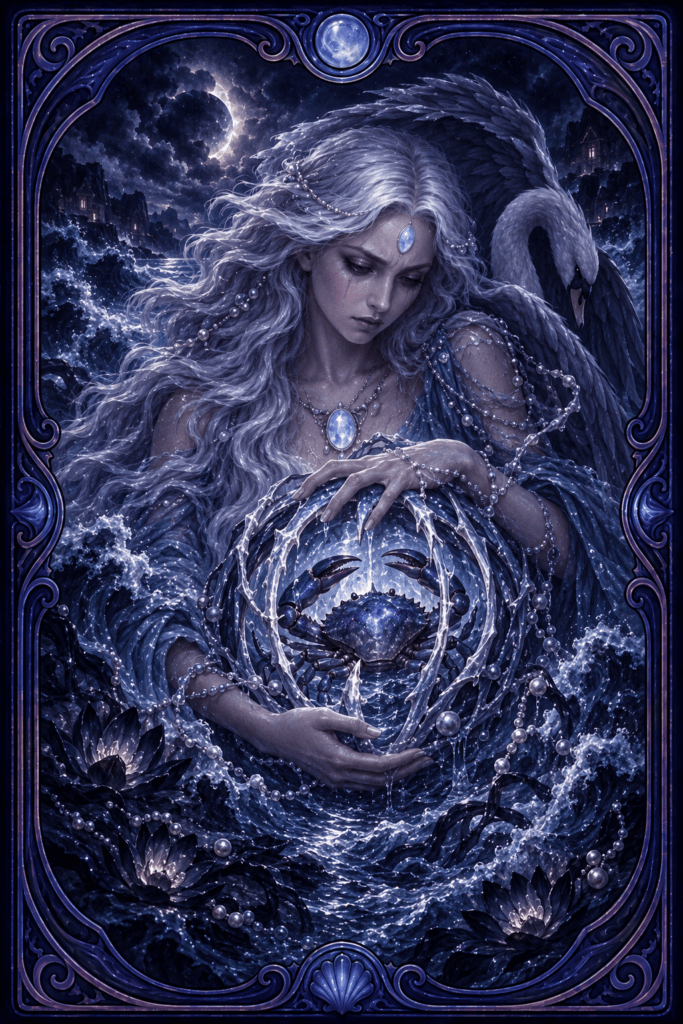
Corruption Path — The Drowning Warden
The Drowning Warden emerges when Cancer becomes convinced that safety can exist only through emotional control.
They build a sanctuary around the bond and gradually remove every exit. Love becomes obligation, family becomes authority, memory becomes prosecution, and sacrifice becomes debt. Anyone attempting independence is treated as though they are abandoning something sacred.
The Warden rarely announces control openly. They create emotional gravity until departure feels cruel. Illness appears when boundaries are asserted. Silence appears when expectations are challenged. Helplessness appears when responsibility must be shared. Past sacrifices return whenever the other person attempts to choose differently.
Water floods the relationship with emotion while Darkness closes the gates. The other person is expected to remain, soothe, explain, reassure, confess, and repeatedly prove loyalty without ever fully resolving Cancer’s fear.
The Warden may genuinely believe they are protecting love from selfishness, detachment, or external corruption. Yet what they preserve is no longer living intimacy. It is enforced continuity.
Eventually, everyone inside the sanctuary becomes exhausted. Some submit and lose themselves. Others escape and confirm Cancer’s deepest fear that people always leave.
The corruption path ends when Cancer recognizes that a relationship maintained through guilt has already lost the safety they were attempting to protect.
The Lunar Guardian becomes free again when the door opens from both sides.

Mastered Path — The Lunar Guardian
Mastered Cancer becomes the keeper of living continuity.
They protect without controlling, remember without imprisoning, nurture without creating dependence, and maintain boundaries without disappearing behind them. Their emotional depth no longer requires others to become mind-readers because they have learned to translate feeling into direct language.
The Lunar Guardian understands that people require both roots and movement. They create homes, families, friendships, teams, and communities where vulnerability can be expressed without humiliation and independence can develop without emotional exile.
Their empathy becomes precise. They know when to comfort, when to confront, when to provide shelter, and when continued rescue would prevent growth.
Memory becomes wisdom rather than evidence. Cancer uses the past to recognize patterns while allowing the present to prove that a different outcome is possible.
Their presence carries emotional gravity without demanding that every person orbit them. Others feel held, but not trapped. Loved, but not owned. Remembered, but not permanently defined by who they once were.
The mastered Cancer does not become invulnerable.
They become secure enough that vulnerability no longer needs to control the room.
Cancer Legacy
Cancer enters the world wherever belonging is needed.
They are caregivers, counselors, teachers, healers, parents, community builders, and protectors. They strengthen the invisible bonds that hold people together.
Their role is not to change the world overnight.
Their role is to ensure there is something worth fighting for when change arrives.
Cancer’s legacy is carried through what continues to feel like home after they are gone.
It may live in children who learned that emotion does not make them weak, friends who discovered that loyalty can survive difficulty, family stories preserved from disappearance, recipes repeated across generations, houses transformed into sanctuaries, communities held together during crisis, or people who became capable of nurturing others because Cancer once nurtured them.
Their influence is often difficult to measure publicly because care becomes embedded in ordinary life. A remembered birthday, protected secret, prepared meal, repaired family bond, defended child, safe conversation, inherited tradition, or room in which somebody was allowed to grieve may alter a life without ever becoming visible as an achievement.
Cancer can leave a darker legacy when unhealed fear is transmitted as emotional obligation. Children inherit guilt, partners inherit responsibility for Cancer’s moods, and family history becomes a chain used to prevent change.
Their true legacy therefore depends upon what their protection teaches.
Does it teach others that love requires self-erasure?
Or does it teach that closeness and individuality can survive together?
The highest Cancer legacy is not a family that never separates.
It is a family whose members know where they belong even after they have developed the courage to leave home.

Cancer and Relationships
Cancer approaches relationships as emotional ecosystems. They notice not only attraction or compatibility, but whether the bond possesses enough safety, memory, reciprocity, and continuity to become inhabitable.
Trust develops through repeated emotional evidence. Cancer watches whether another person remains consistent when stressed, remembers what matters, protects vulnerability, repairs conflict, and behaves privately with the same loyalty they display publicly.
Once trust forms, Cancer invests deeply. They learn the other person’s rhythms, create rituals, remember emotional landmarks, anticipate needs, and weave the relationship into the structure of everyday life. The bond becomes more than affection. It becomes a shared interior world.
This devotion can make Cancer one of the zodiac’s most emotionally supportive companions. They remain present during grief, illness, family crisis, insecurity, and periods when another person has little strength to offer in return.
The danger begins when investment becomes entitlement to permanence. Cancer may believe that because they have loved deeply, sacrificed substantially, or remained during difficulty, the other person now owes continued access.
They also struggle when care becomes uneven. Cancer often gives before asking whether the other person possesses the capacity or willingness to reciprocate. Resentment then grows around a contract that was never consciously negotiated.
Healthy Cancer relationships require direct language. Needs should become requests. Limits should become boundaries. Fear should become disclosure. None of these should remain atmospheric tests.
Cancer also needs partners and friends capable of respecting privacy without enabling withdrawal. They benefit from people who can say, “I know you are hurt, but I will not guess what happened. Tell me when you are ready to speak clearly.”
Mature Cancer does not love less intensely.
They stop requiring intensity to erase the other person’s autonomy.
Cancer and friendship
Cancer tends to build a smaller circle than their social warmth initially suggests. They may know many people, but genuine friendship requires emotional trust, remembered history, and evidence that vulnerability will not become entertainment.
As friends, they are attentive, protective, and deeply personal. They remember what others forget, notice when behaviour changes, offer practical comfort, defend absent friends, and create places where the group can reconnect after life has pulled everyone in different directions.
Cancer often becomes the historian of the friendship. They preserve photographs, stories, traditions, private jokes, anniversaries, and the emotional meaning of earlier chapters. Their friendship provides continuity when other areas of life become unstable.
They can be especially valuable during crisis. Cancer is rarely frightened by grief itself. They can sit inside emotional difficulty without immediately attempting to escape, intellectualize, or make the suffering more socially convenient.
Their shadow appears through possessiveness and unspoken expectation. Cancer may feel displaced when a friend develops new relationships, changes lifestyle, becomes less available, or no longer requires the same level of support.
Instead of admitting jealousy or fear, they may withdraw, become sarcastic, or remind the friend of everything Cancer has done. The friendship becomes a loyalty test nobody knew they were taking.
Cancer may also repeatedly rescue friends who avoid responsibility. Being needed provides security, but it eventually produces exhaustion and contempt.
The mature Cancer friend offers care without making crisis the foundation of the bond. They celebrate another person’s independence, ask directly for reciprocity, and understand that reduced contact does not automatically erase emotional significance.
Their friendship remains one of the safest places in the zodiac when the door is protected by boundaries rather than guarded by guilt.
Cancer as Friends
Emotionally attentive: Notices subtle mood shifts, remembers what matters, and makes you feel genuinely understood.
Protective & nurturing: Shows friendship through care, reassurance, practical support, and creating a sense of belonging.
Deeply loyal: Invests heavily in trusted bonds and rarely forgets who stood beside them when life became difficult.
Smothering Retreat: Tests patience through overprotectiveness, guilt, moodiness, or withdrawing into silence when hurt.
Cancer Role in Romance
Cancer does not experience love as entertainment.
Romantic intimacy becomes a private world constructed between two people: shared routines, remembered details, physical closeness, inside jokes, emotional rituals, familiar rooms, family connections, meals, traditions, future plans, difficult conversations, and the accumulated evidence that two separate lives have gradually become capable of holding one another.
Water makes Cancer emotionally receptive. They want to understand the person beneath the performance: what frightens them, what comforts them, what childhood shaped them, what makes them withdraw, what they need after failure, and which wounds they rarely expose to anyone else.
Darkness makes that intimacy selective. Cancer rarely wants everyone to have equal access. Romantic trust becomes meaningful precisely because some parts of them remain protected from the wider world.
Their courtship may therefore develop through increasing emotional permission rather than pure spectacle. Cancer remembers what their partner likes, creates private rituals, offers practical comfort, checks whether they arrived safely, notices changes in mood, and gradually integrates the person into the rhythms of home and everyday life.
At their best, Cancer becomes one of the zodiac’s most devoted partners. They create relationships where vulnerability does not automatically threaten attraction and where hardship does not instantly erase commitment. Cancer understands that love includes inconvenient seasons.
Their central romantic danger appears when devotion becomes entitlement to permanence.
Cancer may believe that because they remained during someone’s worst period, sacrificed deeply, integrated families, built routines, or invested years into the bond, departure becomes morally illegitimate. Emotional history becomes a contract the other person never consciously signed.
When insecure, Cancer can begin testing love instead of receiving it. They withdraw to see whether the partner follows. They say “nothing is wrong” while waiting to be understood. They become unusually helpful, then resent that the sacrifice was not recognized. Jealousy may hide beneath concern, while fear of abandonment appears as overprotection.
Betrayal therefore cuts Cancer especially deeply. Water experiences the emotional rupture while Darkness preserves the memory. They may forgive behaviour long before their nervous system restores trust. The relationship can continue outwardly while Cancer quietly watches for evidence that the wound is returning.
Mature Cancer understands that lasting love cannot be guaranteed through surveillance, sacrifice, guilt, dependency, or control.
The strongest relationship is not one in which nobody could leave.
It is one in which both people remain while still knowing they are free.
Cancer’s romantic mastery comes when care becomes reciprocal, needs become explicit, boundaries become respected, and the emotional home they create has doors rather than locks.
Then Cancer becomes what their archetype always promised:
A sanctuary.
Not a cage.
Cancer and Love
Cancer loves deeply, loyally, and completely.
They seek emotional trust, genuine intimacy, and a partner who values connection as much as they do. For Cancer, love is not a game—it is a sanctuary.
Their greatest lesson is learning that love cannot be protected through control or sacrifice alone. Mature Cancer learns to nurture without losing themselves.
When balanced, Cancer becomes one of the most devoted and emotionally supportive partners in the zodiac.
Cancer Role in Family
Cancer often becomes the emotional centre of the family long before anyone officially gives them that role.
They remember birthdays, traditions, old conflicts, childhood stories, illnesses, preferences, family rituals, and who stopped speaking to whom ten years ago. Water carries emotional history forward while Darkness protects the continuity of the group. Cancer therefore tends to experience family as something living across time rather than merely a collection of relatives occupying the present.
This can make them exceptional parents, siblings, partners, and caregivers. They notice when a child is frightened beneath misbehaviour, when an elderly relative is becoming isolated, when one sibling is quietly excluded, or when a family tradition provides more psychological stability than outsiders realize.
Cancer understands instinctively that children require roots before independence becomes safe. They create routine, emotional reassurance, familiar environments, shared meals, traditions, bedtime rituals, photographs, stories, and the repeated message that mistakes do not automatically threaten belonging.
Their family role becomes distorted when protection turns into emotional ownership.
A child growing independent may feel to Cancer like the family itself is disappearing. A partner forming stronger outside relationships can activate fears of replacement. New spouses, lifestyles, relocations, careers, and changing traditions may be interpreted through the question: Are we still a family if everything no longer looks the way it did before?
Inverted Cancer can therefore use family identity as leverage.
“We have always done it this way.”
“After everything I sacrificed.”
“You never visit anymore.”
“Family should come first.”
The statements may contain legitimate pain, but they become controlling when history is used to deny another person the right to grow.
Cancer may also inherit family wounds because Darkness preserves what has not been processed. Secrets, resentments, abandoned roles, unspoken grief, generational anxiety, and emotional responsibilities can pass from one generation to another simply because nobody consciously interrupted the pattern.
This gives Cancer enormous cycle-breaking potential.
They can become the family member who finally names what everyone has been protecting through silence. They can preserve the good while refusing to transmit the wound. Tradition remains, but manipulation ends. Loyalty remains, but abuse loses automatic access. Family memory remains, but the next generation is not required to repeat its pain.
The mature Cancer parent does not raise children who never leave.
They create children secure enough to explore because home no longer depends upon obedience.
The mature Cancer family member does not keep everyone permanently close.
They preserve a bond strong enough to survive distance, disagreement, adulthood, and change.
Cancer’s family legacy is therefore measured through something more meaningful than proximity.
It is measured by whether the people they love learned that belonging and freedom can exist inside the same home.
Cancer is often the heart of the family.
They preserve memories, traditions, and bonds that might otherwise fade with time. They instinctively understand that people need roots before they can grow.
Their legacy is not measured by status.
It is measured by the lives made stronger through their care.
Cancer vs their Element Zodiacs
Cancer shares Water with Pisces and Scorpio. All three possess emotional depth, sensitivity, attachment, intuition, and the capacity to perceive what exists beneath visible behaviour. Their Prime Elements determine what Water does with what it feels.
Cancer carries Water through Darkness. It contains, remembers, protects, and gives emotion a boundary.
Pisces carries Water through Aether. It expands, imagines, dissolves, and searches for meaning beyond boundaries.
Scorpio carries Water through Nether. It concentrates, intensifies, transforms, and forces hidden emotion toward consequence.
Cancer shelters.
Pisces transcends.
Scorpio transforms.
How Cancer Differs From Other Water Signs
Cancer and Pisces
Cancer is not Pisces’s boundless ocean.
Pisces is Water shaped by Aether. Emotion expands into imagination, symbolism, spirituality, possibility, and identification with experiences beyond the individual self. Its Chaotic Energy develops through friction between emotional connection and dissolving boundaries.
Cancer is Water shaped by Darkness. Emotion is given enclosure, memory, loyalty, privacy, and a defined field of belonging. Its Pure Energy concentrates feeling into an internally coherent chamber.
Pisces asks:
“What connects all of us beneath the surface?”
Cancer asks:
“Who belongs inside the circle I am responsible for protecting?”
Pisces may empathize universally, feeling the suffering of strangers, archetypes, imagined worlds, distant communities, and people they barely know. Cancer’s empathy is more gravitational. It deepens around history, family, proximity, repeated care, and emotional responsibility.
Pisces seeks transcendence through connection. Cancer seeks continuity through connection.
Their approaches to pain also differ. Pisces may dissolve into fantasy, spirituality, creativity, avoidance, or identification with the collective wound. Cancer retreats toward memory, privacy, family, familiar environments, and the people or rituals that restore emotional belonging.
Both can lose boundaries. Pisces loses the boundary by becoming everything. Cancer loses it by making everything inside the bond part of themselves.
Their shadows therefore diverge. Pisces escapes when reality feels too defined or painful. Cancer encloses when reality feels too unstable or exposed.
One turns the ocean into a dream.
The other turns it into a protected cove.
Cancer and Scorpio
Cancer is not Scorpio’s emotional underworld.
Scorpio is Water shaped by Nether. It intensifies emotion through pressure, confrontation, desire, rupture, truth, death, renewal, and irreversible transformation. Its Nova Energy causes emotional investment to gather momentum until something hidden must change.
Cancer is Water shaped by Darkness. It gives emotion continuity through memory, belonging, nurture, protection, and selective access. Its Pure Energy seeks to preserve the emotional centre rather than force transformation through it.
Scorpio asks:
“What truth must be confronted before this bond can become real?”
Cancer asks:
“What must be protected for this bond to remain emotionally alive?”
Cancer often responds to pain by creating shelter. Scorpio responds by descending into the pain until its hidden power, motive, betrayal, or desire is exposed.
Cancer values familiarity because familiarity supports safety. Scorpio may deliberately disturb familiarity when it begins concealing decay.
Both are private and loyal, but their privacy serves different purposes. Cancer conceals what remains vulnerable. Scorpio conceals what could be used against them or what must gather sufficient power before revelation.
Their shadows are equally intense but structurally different. Cancer controls through guilt, dependency, memory, and withdrawal. Scorpio controls through pressure, obsession, leverage, confrontation, and psychological domination.
Cancer fears that the bond will disappear.
Scorpio fears that the bond is false.
One protects the emotional home.
The other burns through its floorboards to discover what was buried beneath it.
How Cancer Differs From Other Darkness Signs
Cancer shares Darkness with Taurus and Libra. All three regulate attachment, access, privacy, protection, memory, value, and relational consequence. Their Core Elements determine what Darkness contains.
Cancer carries Darkness through Water. It protects emotional belonging, family, vulnerability, and memory.
Taurus carries Darkness through Earth. It protects embodied value, resources, comfort, loyalty, and material continuity.
Libra carries Darkness through Air. It protects relationship through negotiation, reciprocity, proportion, and controlled social access.
Cancer shelters.
Taurus preserves.
Libra balances.
Cancer vs. Taurus
Cancer is not Taurus’s material sanctuary.
Taurus is Earth shaped by Darkness. It gives value physical continuity through routine, resources, touch, provision, ownership, labour, and sustained investment. Its Nova Energy causes value to deepen through accumulation.
Cancer is Water shaped by Darkness. It protects the emotional interior through empathy, memory, reassurance, attachment, privacy, and nurture. Its Pure Energy forms a concentrated chamber of belonging.
Taurus asks:
“Can this still be trusted to remain?”
Cancer asks:
“Do I still belong here emotionally?”
Taurus protects the conditions surrounding the bond. Cancer protects the feeling inside it. Taurus may nurture through food, money, repair, physical presence, consistency, and practical support. Cancer nurtures through listening, recognition, remembered details, emotional reassurance, and the creation of psychological safety.
Both resist release because Darkness remembers investment. Taurus remembers labour and material continuity. Cancer remembers intimacy and emotional history.
Their shadows resemble each other but arise from different fears. Taurus becomes possessive because separation threatens accumulated stability. Cancer becomes smothering because separation threatens emotional belonging.
Taurus builds the walls around the home.
Cancer keeps the heart inside those walls alive.
Cancer vs. Libra
Cancer is not Libra’s negotiated intimacy.
Libra is Air shaped by Darkness. It manages relationship through language, comparison, reciprocity, social awareness, attraction, diplomacy, and continual adjustment between self and other. Its Chaotic Energy recalibrates because Air seeks exchange while Darkness regulates access.
Cancer is Water shaped by Darkness. It manages relationship through emotional continuity, memory, attunement, care, and the protection of vulnerability. Its Pure Energy seeks a stable centre of belonging.
Libra asks:
“What arrangement preserves fairness between us?”
Cancer asks:
“What emotional bond makes this arrangement worth preserving?”
Libra creates safety through clarity, proportion, agreement, and mutual recognition. Cancer creates safety through trust, emotional availability, loyalty, and the belief that weakness will not result in exile.
Libra may appear more open because Air communicates readily, yet its deeper access remains carefully negotiated. Cancer may appear more private because Water exposes the person to emotional absorption, making selective boundaries necessary.
Their shadows also differ. Inverted Libra manipulates through charm, ambiguity, social pressure, triangulation, or selective fairness. Inverted Cancer manipulates through guilt, withdrawal, sacrifice, mood, or emotional dependency.
Libra controls the distance between two people.
Cancer controls the emotional gravity pulling them together.
One protects relationship through balance.
The other protects it through belonging.
Cancer Zodiac Affinity
Cancer is the harbor in the storm. Water grants emotional depth, empathy, and connection, while Darkness provides wisdom, boundaries, and the instinct to protect what matters. They understand that strength is not always loud—sometimes it is the quiet hand that holds everything together when others fall apart. Cancer nurtures, remembers, and safeguards the bonds that give life meaning. Their heart is deep, their trust is earned, and their loyalty is rarely forgotten. Neither is betrayal.
Capricorn (Earth + Nether)

A hearth built upon stone — emotion finds structure, protection gains endurance, and care learns how to become legacy.
Best
Elemental
Synergy:
Cancer and Capricorn
The Hidden Dynamic
Cancer and Capricorn create one of the most structurally complete pairings in the Octa Zodiac. Cancer brings Water and Darkness: emotional continuity, empathy, memory, protection, and belonging. Capricorn brings Earth and Nether: structure, endurance, ambition, pressure, and transformation through consequence.
Water strengthens Earth by giving structure a living purpose. Earth gives Water a channel through which care can become tangible. Darkness and Nether reinforce one another because protection requires the capacity to confront, rebuild, and survive pressure.
Cancer asks why the kingdom matters.
Capricorn determines how the kingdom will endure.
Cancer recognizes the people hidden beneath the plan. Capricorn recognizes the structure required to protect those people over time. Cancer creates emotional loyalty; Capricorn converts loyalty into responsibility, provision, boundaries, and long-term construction.
Both carry Pure Energy, which means neither enters the bond casually once it has become part of identity. This creates exceptional durability, but it also makes conflict difficult because both may experience compromise as a threat to the structure they are protecting.
The Consequence of Misalignment
The Price of Protection
When misaligned, Cancer and Capricorn divide the relationship into emotion and duty.
Cancer believes Capricorn no longer cares because affection has been replaced by responsibility, work, correction, or practical provision. Capricorn believes Cancer no longer respects reality because emotion appears to override boundaries, consequences, or necessary decisions.
Cancer responds by seeking more reassurance, increasing emotional pressure, or withdrawing into hurt. Capricorn responds by becoming more controlled, distant, authoritative, or absorbed in work. Each reaction intensifies the other.
The bond can become a household that functions externally while starving internally. Everything is paid, maintained, scheduled, and protected, but tenderness becomes rare. Alternatively, emotion dominates every decision until Capricorn feels trapped inside an atmosphere where no practical limit can be asserted without being interpreted as rejection.
Cancer controls through emotional obligation.
Capricorn controls through structural authority.
Both call it protection.
Neither notices that the protected relationship has stopped breathing.
When This Bond Blooms
This pairing blooms when Cancer respects Capricorn’s need for responsibility without treating restraint as emotional absence, and Capricorn respects Cancer’s need for reassurance without treating sensitivity as incompetence.
Shared projects strengthen them. A home, family, business, community, long-term investment, creative legacy, or difficult mission gives both signs something meaningful to protect through their complementary strengths.
Cancer should state emotional needs directly rather than forcing Capricorn to decode the atmosphere. Capricorn should express affection before Cancer is required to prove distress strongly enough to interrupt the plan.
When aligned, Cancer gives Capricorn a reason to return from the summit. Capricorn gives Cancer a foundation strong enough that every emotional storm does not threaten the entire home.
Together, they create continuity with direction.
Capricorn vs. Cancer in a Nutshell
Cancer protects the life inside the structure.
Capricorn protects the structure around the life.
Cancer remembers why people need a home.
Capricorn ensures the home can survive winter.
At their best, they build legacies capable of holding both love and consequence.
At their worst, one becomes the wounded heart of the household while the other becomes its unapproachable authority.
Leo (Fire Light)
Moonlight beneath the noonday sun — privacy meets visibility, protection collides with expression, and the hidden heart faces the courage to be seen.
Highest Elemental Opposition:
Cancer and Leo
The Hidden Dynamic
Cancer and Leo stand across a complete elemental divide.
Cancer is Water + Darkness. Water moves through emotional connection while Darkness protects, remembers, conceals, and regulates access.
Leo is Fire + Light. Fire asserts visible will while Light reveals, directs, evaluates, and places identity beneath conscious illumination.
Cancer finds power in intimacy.
Leo finds power in expression.
Cancer protects what becomes vulnerable under exposure. Leo believes what is valuable should possess the courage to become visible. Cancer asks who requires care. Leo asks who requires confidence.
Both carry Pure Energy, which means their elemental values become pillars of identity. Neither experiences the disagreement as a minor preference. Cancer may believe Leo’s visibility threatens emotional safety. Leo may believe Cancer’s retreat threatens honesty and vitality.
Yet the attraction can be substantial. Leo brings warmth into Cancer’s protected world. Cancer gives Leo an intimate place where performance is no longer necessary.
One creates the hearth.
The other becomes its flame.
The Consequence of Misalignment
The Price of Exposure
When misaligned, Leo’s need for recognition collides with Cancer’s need for emotional consideration.
Cancer may experience Leo as self-centred, loud, insensitive, dramatic, or unwilling to recognize needs that are not publicly expressed. Leo may experience Cancer as indirect, controlling, pessimistic, withdrawn, or capable of turning every independent act into evidence of disloyalty.
Cancer retreats when hurt.
Leo becomes more visible when ignored.
Cancer interprets the increased display as proof that Leo cares only about themselves. Leo interprets Cancer’s withdrawal as punishment designed to deny affection and recognition.
The opposition can then become theatrical in different directions. Leo performs openly. Cancer performs through atmosphere. One raises the volume. The other removes warmth from the room.
Fire can evaporate Water.
Water can extinguish Fire.
Light overexposes what Darkness was protecting, while Darkness conceals the recognition Light requires.
Both eventually feel unseen.
When This Bond Blooms
This bond blooms when Leo learns that emotional privacy is not shame and Cancer learns that visibility is not betrayal.
Leo can help Cancer express needs, ambitions, creativity, and identity before they become hidden beneath service to others. Cancer can help Leo distinguish genuine recognition from applause and discover intimacy beyond public confidence.
Cancer must communicate directly rather than expecting Leo to detect every hidden emotional shift. Leo must offer reassurance privately rather than assuming public loyalty or visible affection should be sufficient.
When aligned, Leo gives Cancer courage to step beyond the shell. Cancer gives Leo a place where the armour of confidence can be removed without losing dignity.
Together, they unite the private heart and the visible self.
Leo vs. Cancer in a Nutshell
Leo says:
“Let what you love become visible.”
Cancer says:
“Protect what you love from careless exposure.”
Leo gives the hearth radiance.
Cancer gives the flame somewhere to belong.
At their best, courage learns tenderness and tenderness learns courage.
At their worst, one burns for attention while the other floods the room with everything that was never said.
What is Cancer known for?
What is Cancer known for?
Cancer is known for emotional intelligence, loyalty, protection, memory, empathy, and the ability to create a genuine sense of belonging. Within the Octa framework, Water gives Cancer sensitivity, connection, patience, and emotional depth, while Darkness gives those feelings boundaries, gravity, memory, and protection.
Cancer does not simply care about people in the present moment. They remember relationships through time. At their best, they create environments where vulnerability can exist without becoming weakness. Their challenge begins when protection becomes possession, m
What are Cancer's strongest traits?
Cancer’s strongest traits include emotional attunement, protective loyalty, relational memory, nurturing presence, patience, empathy, and continuity under pressure.
Water allows Cancer to notice emotional shifts that others may overlook, while Darkness helps them remember what those shifts mean within the history of a relationship. This makes Cancer particularly strong during grief, illness, family crisis, insecurity, and periods when someone they love has little strength to offer in return.
Their greatest gift is not merely sensitivity. It is the ability to turn sensitivity into shelter: making another person feel remembered, protected, and allowed to belong even when life becomes difficult.
What are Cancer's biggest weaknesses?
Cancer’s weaknesses usually appear when emotional protection becomes excessive. They may become overly attached, martyr-like, smothering, resentful, withdrawn, suspicious, guilt-inducing, or unable to release old wounds.
Because Cancer remembers emotionally, a current disagreement may awaken an entire archive of previous disappointments. Instead of addressing the present problem directly, they may respond to several years of accumulated meaning at once.
Cancer becomes most distorted when care acquires an invisible price. They give without stating limits, expect others to recognize the sacrifice, and later experience insufficient reciprocity as proof that the relationship was never valued equally.
Why does Cancer withdraw when hurt?
Cancer often withdraws because Water experiences conflict relationally while Darkness protects vulnerability through containment. When hurt, their instinct may be to reduce access before explaining exactly what happened.
This can appear as silence, shorter replies, emotional distance, reduced affection, or retreat into familiar spaces. Healthy withdrawal gives Cancer enough privacy to understand the feeling before speaking.
The shadow appears when withdrawal becomes punishment or a loyalty test. Cancer may expect the other person to notice what changed and prove their care by pursuing them. Mature Cancer learns to use the shell as a temporary boundary rather than an emotional maze others must solve.
What does Pure Energy mean for Cancer?
Cancer is a Pure Energy sign. Within Octa, Water and Darkness directly reinforce one another, concentrating emotional continuity, attachment, memory, protection, privacy, and belonging into a coherent internal structure.
For Cancer, the underlying Pure declaration is: “These bonds define me.”
This can create extraordinary loyalty and resilience. Cancer may remain emotionally connected through illness, grief, distance, hardship, and temporary failure because the bond is not valued only for its pleasant moments.
The danger is emotional enclosure. When Cancer’s internal interpretation becomes too protected, memory and intuition may reinforce one another until present evidence struggles to enter. Mastery means protecting the sanctuary without sealing it from new truth.
What planet rules Cancer in the Octa Zodiac Framework ?
The Moon rules Cancer in the Octa Zodiac Framework and governs emotional gravity.
The Moon describes how experience becomes emotionally significant, absorbed into memory, attached to identity, and carried forward through relationships. Through Cancer’s Water + Darkness configuration, this becomes especially concentrated around attachment, belonging, care, privacy, memory, and protection.
Balanced Moon creates secure belonging: the ability to remember without becoming imprisoned by memory and protect without controlling.
Inverted Moon turns attachment into dependency, memory into grievance, privacy into isolation, and nurture into smothering. Cancer reaches its highest lunar expression when safety remains strong enough to permit growth rather than prevent it.
What is Cancer like in love?
Cancer approaches love as the creation of a private emotional world between two people. Shared routines, remembered details, physical closeness, meals, traditions, inside jokes, difficult conversations, family connections, and accumulated history all become part of the bond.
Water makes Cancer emotionally receptive, while Darkness makes intimacy selective. They want to understand the person beneath the performance, but they also need to trust that what becomes vulnerable will remain protected.
Balanced Cancer becomes deeply loyal, nurturing, affectionate, and emotionally dependable. Their romantic challenge is learning that devotion does not create entitlement to permanence. Love is strongest when both people remain because they continue choosing the bond, not because guilt or dependency has made leaving impossible.
Why does Cancer have difficulty letting go?
Cancer does not experience important endings as simple absence. A person may be connected to routines, memories, imagined futures, family relationships, places, objects, traditions, and an entire version of Cancer’s own identity.
Water preserves emotional continuity while Darkness stores meaning. Letting go can therefore feel like destroying something rather than allowing it to change form.
This is why Cancer may hold onto old relationships, messages, grievances, rituals, or hopes long after living connection has changed.
Their growth requires understanding that release does not erase significance. Something can have mattered deeply and still be finished. Memory can remain sacred without being given permanent control over the present.
What is the best zodiac match for Cancer?
Within the Octa Zodiac affinity structure, Capricorn is Cancer’s strongest elemental synergy.
Cancer brings Water + Darkness: emotional continuity, empathy, memory, protection, and belonging. Capricorn brings Earth + Nether: structure, endurance, responsibility, pressure, and transformation through consequence.
Cancer protects the life inside the structure. Capricorn protects the structure around the life.
At their best, Cancer gives Capricorn a reason to return from achievement and responsibility, while Capricorn gives Cancer foundations strong enough that every emotional storm does not threaten the entire home. Together they can build relationships, families, businesses, homes, or long-term legacies that combine emotional meaning with practical endurance.
This is an Octa compatibility interpretation rather than a guarantee of relationship success.
What is the worst zodiac match for Cancer?
Within the Octa framework, Leo is Cancer’s highest elemental opposition.
Cancer carries Water + Darkness, while Leo carries Fire + Light. Cancer protects vulnerability, privacy, emotional continuity, and belonging. Leo emphasizes visible expression, conscious identity, confidence, radiance, and recognition.
Cancer finds power through intimacy. Leo finds power through expression.
When misaligned, Cancer may experience Leo as overly loud, self-focused, or insensitive to needs that are not openly expressed, while Leo may experience Cancer as indirect, withdrawn, or emotionally controlling.
The opposition is not automatically doomed. At its best, Leo teaches Cancer greater visibility and courage, while Cancer teaches Leo tenderness and intimacy beyond performance. But within Octa’s elemental structure, this pairing creates Cancer’s strongest natural friction.
What does an unhealthy Cancer look like?
An unhealthy Cancer may become emotionally controlling, resentful, possessive, withdrawn, martyr-like, suspicious, nostalgic, passive-aggressive, or excessively dependent upon being needed.
Water can turn sensitivity into martyrdom and flow into stagnation. Darkness can turn protection into isolation, reflection into rumination, and nurture into smothering.
The resulting shadow attempts to make relationships emotionally heavy enough that they cannot leave. Love becomes obligation. Memory becomes leverage. Sacrifice becomes debt.
Cancer’s darkest distortion is not simply moodiness. It is the belief that love can be made safe by removing another person’s freedom to withdraw it.
What is Cancer's core wound?
Cancer’s core wound is The Unheld One: the fear that emotional care may disappear precisely when it is needed most.
Cancer may become especially sensitive to experiences involving emotional neglect, inconsistent affection, family instability, abandonment, premature responsibility, or situations where they were expected to understand everyone else while nobody adequately understood them.
The internal belief becomes: “If I am not necessary, I may not be kept.”
Cancer may therefore become indispensable through caregiving, emotional labour, remembering, protecting, and anticipating needs.
Healing begins when they discover that belonging does not need to be purchased through usefulness. They can be loved without constantly earning their place by holding everyone else together.
What is Cancer's main growth lesson?
Cancer’s central growth lesson is learning that protection and control are not the same thing.
They must separate being needed from being loved, intuition from old emotional memory, nurture from dependency, privacy from punishment, and loyalty from permanent obligation.
Their growth deepens when needs become direct requests rather than hidden tests, boundaries become language rather than withdrawal, and grief is allowed to complete its movement.
The Lunar Guardian reaches mastery when they create safety strong enough to support independence. A healthy home does not prevent anyone from leaving. It becomes somewhere people can return without surrendering the lives they developed outside it.
How is the Octa interpretation of Cancer different from traditional astrology?
Traditional astrology already associates Cancer with emotion, family, nurturing, memory, home, sensitivity, and the Moon. The Octa interpretation attempts to explain the psychological architecture beneath those recognizable traits.
Cancer is understood through Water as the Core Element, Darkness as the Prime Element, Pure Energy as the concentration of those mutually reinforcing forces, and the Moon as the planetary function of emotional gravity.
This turns “nurturing” from a personality adjective into a mechanism involving attachment, memory, boundaries, emotional continuity, protection, and belonging.
Octa remains a symbolic interpretive framework rather than a scientifically validated personality model, so these descriptions are best used for reflection rather than deterministic claims about every Cancer.