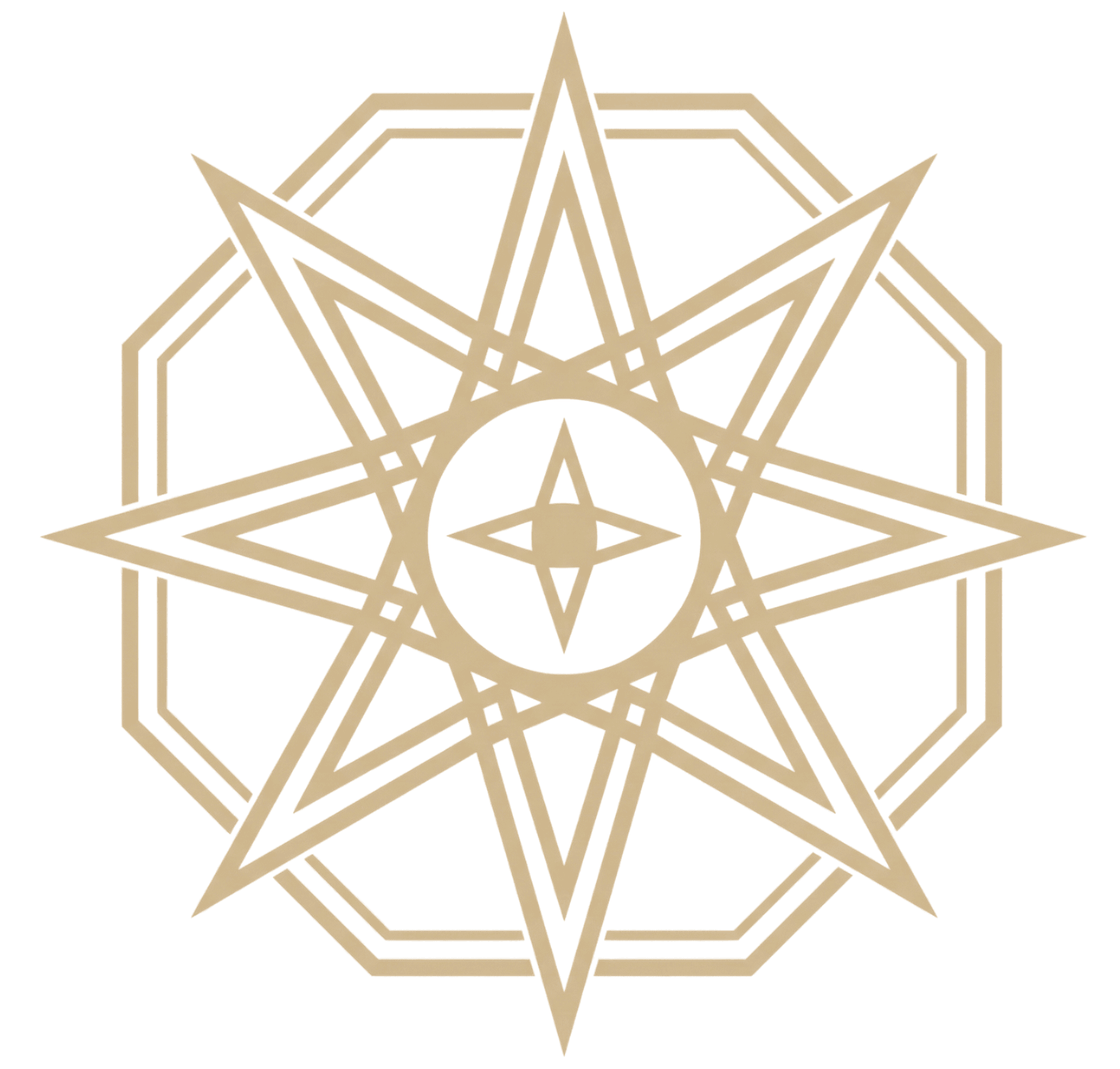
Those who have done their own research—and weren’t blindly dismissing anything that lingers beyond current scientific explanation—might already sense this: so‑called “magic elements” are not just edgy occult terms or video‑game labels. They are symbolic languages humans have used for millennia to describe forces we experience but struggle to measure directly—patterns of action, emotion, thought, structure, meaning, and change.
In mystic philosophy, everything is interconnected. Across cultures and eras, thinkers noticed that reality seems to organize itself around a small number of recurring forces. These forces don’t replace science or psychology; they offer a different lens—one concerned with meaning, pattern, and lived experience rather than prediction.
That lens is what we call: Sun‑Noir’s Octa Element Framework.
We did not arrive at this system through belief, faith, or blind reverence for the occult. We arrived here the same way we approach everything else: skeptics first. We are agnostic by nature, pro‑science by instinct, grounded in psychology and pattern recognition rather than mysticism.
Over time, however, a pattern became difficult to ignore. Modern psychology, ancient symbolism, and even fragments of early cosmology often describe the same structures—just in different languages. Where psychology speaks of drives, cognition, attachment, shadow, and integration, older systems spoke in elements.
What troubled us was not astrology itself, but how flat it often becomes when stripped of its deeper structure. People are clearly interconnected—and clearly different—yet most modern interpretations struggle to explain both at once without collapsing into stereotypes.
The Octa Element System emerged as an attempt to explore that missing layer. Not to replace astrology. Not to correct it. But to add a symbolic depth layer that helps explain why similar signs feel radically different, and how inner tensions shape behavior over time.
We are not oracles, prophets, or authorities—just humans connecting dots, testing ideas, and observing patterns. What follows is an invitation, not a doctrine.
At its most basic level, the Octa framework works with eight elemental archetypes. They are grouped into two symbolic tiers:
• A material layer, describing how energy tends to act in the world • A meta layer, describing why that energy moves the way it does
This distinction matters. Most systems describe behavior. Fewer attempt to describe motivation and direction separately.
We deliberately keep the public explanation symbolic rather than mechanical. The system is meant to be experienced and reflected on—not reverse‑engineered from a chart.
Below are brief, non‑technical descriptions of the eight elemental archetypes as symbolic forces. These are not instructions, formulas, or exhaustive definitions.
Fire — Initiation & Momentum Fire symbolizes the drive to act, assert, and begin. It represents ignition: the moment potential becomes motion. In people, Fire often shows up as courage, motivation, leadership, and the urge to move forward.
Water — Depth & Continuity Water symbolizes emotional connection, memory, and internal flow. It governs how experiences are absorbed, processed, and carried forward. In people, it often appears as empathy, bonding, intuition, and sensitivity.
Air — Mind & Exchange Air symbolizes cognition, language, and movement of ideas. It governs curiosity, communication, and adaptability. In people, it often appears as wit, learning, abstraction, and social exchange.
Earth — Form & Endurance Earth symbolizes structure, persistence, and material reality. It governs discipline, responsibility, and the ability to sustain what has been started. In people, it often appears as reliability, patience, and grounded effort.
Light — Direction & Meaning Light symbolizes clarity, values, and conscious orientation. It governs how meaning is assigned and what is considered worthy of pursuit. In people, it often appears as integrity, ideals, and the desire to guide or refine.
Darkness — Containment & Boundary Darkness symbolizes depth, memory, and gravity. It governs limits, protection, and what is held rather than displayed. In people, it often appears as loyalty, caution, privacy, and emotional weight.
Nether — Pressure & Transformation Nether symbolizes change through intensity. It governs breakdown, challenge, and forced evolution. In people, it often appears as ambition, confrontation, rebellion, and the drive to transform.
Aether — Expansion & Perspective Aether symbolizes abstraction, vision, and unity beyond form. It governs imagination, pattern recognition, and transcendence. In people, it often appears as curiosity for the bigger picture, innovation, and future‑oriented thinking.
Within the Octa framework, zodiac signs are not treated as single‑element caricatures. Each sign is understood as a specific configuration of forces—one shaping how it operates in the world, another shaping its deeper pull and orientation.
We intentionally avoid publishing full mappings or mechanical rules here. Not because they are secret in a mystical sense, but because symbolic systems lose their value when reduced to lookup tables.
What matters publicly is the principle:
• No sign is one‑dimensional • Tension between forces is normal, not a flaw • Stability, change, and adaptation are all necessary roles
When viewed this way, zodiac signs stop behaving like tribes and start behaving like instruments—distinct, interactive, and interdependent.
Across observation, elemental configurations tend to express energy in three broad behavioral modes:
• Initiating — energy that creates momentum and direction • Stabilizing — energy that holds structure and continuity • Transforming — energy that disrupts stagnation and enables change
These modes are not personalities. They are patterns of motion. Every living system requires all three to function.
We deliberately describe these modes metaphorically rather than mathematically. The goal is orientation, not optimization.
The classical four‑element model is elegant—but blunt. Grouping three zodiac signs under one element often obscures their differences rather than clarifying them.
The Octa approach does not discard the classical model. It refines it by acknowledging polarity, depth, and dual expression—ideas already present in Hermetic philosophy, psychological shadow theory, and mythic cosmology.
This isn’t about adding complexity for its own sake. It’s about matching lived experience more honestly.
Strengths: • Greater nuance without moral hierarchy • Compatibility with psychology and symbolism • Emphasis on patterns, not labels • Focus on movement and integration rather than prediction
Limits: • More abstract than pop astrology • Requires reflection, not instant answers • Not empirically “provable” in a scientific sense • Easily misunderstood if treated as dogma
This framework is not here to replace thinking. It assumes thinking.
This is: • A symbolic framework • A tool for self‑observation • A language for describing inner tensions and growth
This is not: • A belief system • A personality cage • A prediction engine • A replacement for psychology, science, or lived judgment
Maybe this means nothing. Maybe it’s just another strange document drifting through the digital void.
Or maybe it’s a reminder that the zodiac was never meant to be flat.
Above and below. Form and meaning. Action and intention.
We invite you to explore the possibility—not to adopt new dogma.