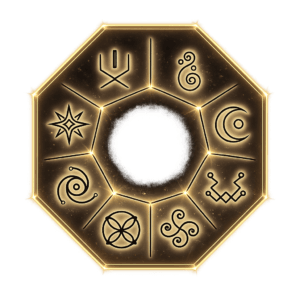
Since the dawn of civilization, humans have tried to make sense of the world by breaking it into elemental pieces. Fire, Water, Air, and Earth—everyone knows these. Ancient Greeks wrote about them (Empedocles, 5th c. BCE; Aristotle, 4th c. BCE), alchemists chased them in Europe (16th–17th c.), and astrologers still do a soft echo of it today. But if you look closer, a deeper, eightfold pattern has been whispering across cultures, always the same, always subtle. Various patterns scattered like pages of an ancient grimoire across timelines, cultures, and mythos.
We’re not talking mystical fan fiction. We’re talking about what humans have noticed about how energy moves and why it moves—in nature, in thought, in human hearts—long before we had science to label it.
Across Greek, Chinese, Egyptian, and Vedic traditions, four forces consistently describe the material plane:
Fire – Ignition, will, action. The spark that turns possibility into reality. (Greece: Empedocles/Agni in Veda, China: Huo in Wuxing)
Water – Connection, continuity, emotional intelligence. The river of experience flowing through life. (Greece: Apas, India: Upas/Prithvi, China: Shui, Egypt: Nun)
Air – Thought, exchange, interpretation. The wind carrying ideas, meaning, and insight. (Greece: Aer, India: Vayu, Egypt: Shu, China/Japan: Feng/Fū)
Earth – Form, discipline, endurance. The container that holds reality in place. (Greece: Gaia, India: Prithvi, Egypt: Geb, China: Tu)
Look at any mythic story and these show up. Prometheus steals fire; rivers carry memory and transformation; Hermes flies on the wind, bringing messages; mountains hold gods, treasures, and secrets. Even practical life obeys the same pattern. Core elements describe what moves and how.
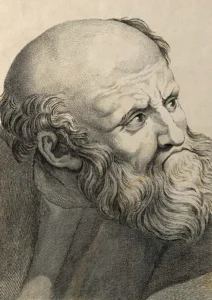
Empedocles’ philosophy is known best for originating the cosmogonic theory of the four classical elements.
The Hidden Counterpart: Why Energy Moves
Beyond the obvious, ancient traditions hint at another layer: forces that shape motivation, consequence, and transcendence. Taoism calls it Yin-Yang (c. 4th–3rd c. BCE). Zoroastrians spoke of Light and Darkness in cosmic balance (Ahura Mazda vs. Angra Mainyu, c. 6th c. BCE). Hermeticists insisted that “as above, so below” meant the material world mirrored the spiritual one (3rd–1st c. BCE Egypt). Here’s what consistently shows up:
Light – Guidance, clarity, conscious evaluation. Reveals what matters. (Egypt: Ra, China: Yang, Zoroastrian: Ahura Mazda, Hinduism: Rta)
Darkness – Depth, containment, memory. Holds what is not yet ready to be revealed. (Egypt: Apophis, China: Yin, Zoroastrian: Angra Mainyu, Shinto: Kurai)
Aether – Perception beyond form, unity, abstraction. Sees invisible connections. (India: Akasha, Alchemy: Mercury, Tibet: Lung, Shinto: Kuzunoha)
Nether – Pressure, transformation, consequence. Breaks the old to make room for new. (Alchemy: transformative principle, Egyptian chaos forces, Zoroastrian destructive aspects)
Every culture describes these, just in different garb. Egyptian Ogdoad had eight primordial forces (c. 3000 BCE). Taoists and Shinto recognized dualities beyond the visible. Alchemists and Hermetic philosophers mirrored the four elements into spiritual counterparts. This is not coincidence—it’s pattern recognition across millennia.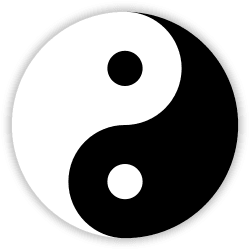
Greek philosophy: Fire, Water, Air, Earth as roots; some schools hinted at higher forms of each element. (Empedocles 5th c. BCE; Aristotle 4th c. BCE)
Hermeticism: Each element has a mirrored astral or spiritual expression. As above. So below. (3rd c.–1st c. BCE, Egypt)
Taoist/Yin-Yang: Every active force contains its receptive reflection; balance creates motion. (4th–3rd c. BCE)
Shinto cosmology: Kami embody both visible and hidden energies, physical and spiritual. (7th c. CE codification)
Egyptian Ogdoad: Eight primordial forces—chaos, darkness, water, air, and their counterparts—laid the blueprint for later esoteric systems. (c. 3000 BCE)
Notice the repetition? Four physical forces mirrored by four higher or hidden vectors. It’s like humanity kept drawing the same energetic skeleton in different ink across thousands of years.
Understanding this pattern is more than trivia. It explains why some people “feel like air trapped in a water sign” (Pisces → Water + Aether) or why fire sometimes burns inward instead of outward (Scorpio → Water + Nether). The world operates on multiple layers at once: what moves, and why it moves. Civilizations intuitively recognized this. Mythology, alchemy, astrology—they all encode these truths in symbolic language.
| Zodiac | Traditional Element | Octa Reinterpretation | Insight |
|---|---|---|---|
| Pisces | Water | Water + Aether | Intuition and perception dominate over pure emotional flow |
| Scorpio | Water | Water + Nether | Transformation and internal pressure drive action |
Fire moves. Water connects. Air interprets. Earth holds.
Light guides. Darkness contains. Aether perceives. Nether transforms.
Eight forces. Two planes. One pattern.
Every ancient system you study—from Greek to Shinto, from Hermetic to Vedic—has been hinting at the same truth: energy is never singular. Every action has a reason, every form has a shadow, and the visible always mirrors the invisible. Humans have been noticing this for thousands of years, and now, for the first time in this clarity, the pattern is visible across time and culture.
It’s not magic. It’s observation.
It’s humanity mapping the hidden architecture of existence—and laughing a little, because we kept forgetting it and calling it something else every few centuries.
Once again, we do not ask you to believe. We invite you to entertain the idea of Octa elements.